Unmissable Travel Offers
Discover the world with South Coast Cruise & Travel’s Special Tours Around the World. From vibrant cities and cultural landmarks to breathtaking natural wonders, curated journeys that take you beyond the ordinary. Whether you’re drawn to luxury ocean voyages, boutique small-ship adventures or immersive river cruises, our expert team ensures every detail is tailored to create unforgettable travel experiences.
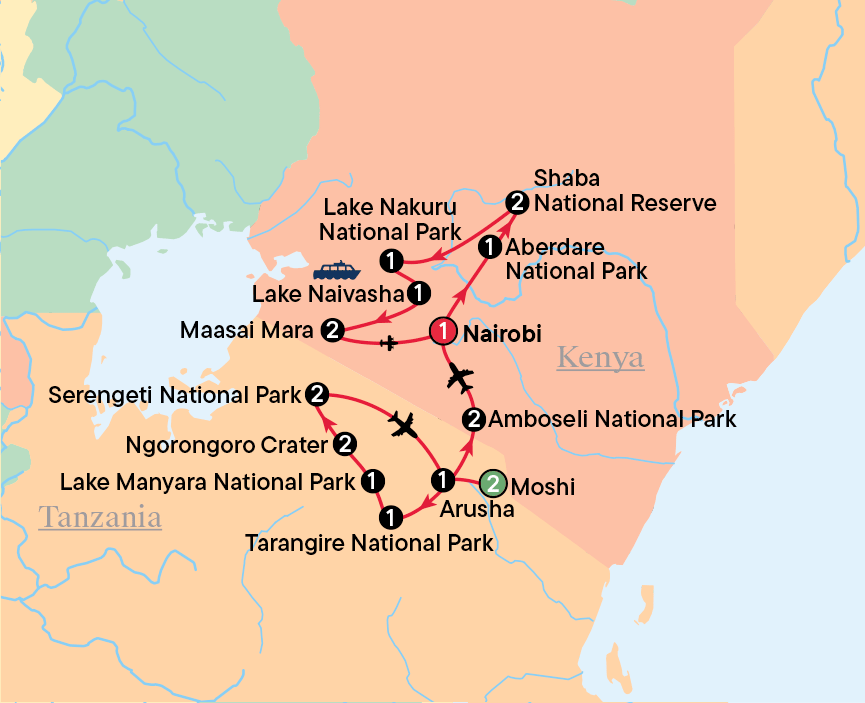
Kenya & Tanzania
Tour Enquiry
Kenya & Tanzania
About the tour
Itinerary
1
Depart Australia
2
Arrive Arusha
Welcome to Tanzania, a country known for its stunning natural beauty, diverse wildlife and vibrant culture. We begin in Arusha, a vibrant city located in northern Tanzania, at the base of Mount Meru. Referred to as the ‘safari capital’ of Tanzania, it serves as the gateway to many of the country's most famous national parks and wildlife reserves, including the Serengeti, Ngorongoro Crater and Tarangire. We don’t want you to miss out on any aspect of your small group tour. To ensure that you don’t, we recommend you arrive at your hotel by 6.30pm. Tonight, join your fellow travellers for a welcome drink. For clients who arrive later than 6.30pm, you will receive your welcome drink upon arrival along with a letter advising meeting time for tomorrow morning.
3
Arusha
Today is dedicated to exploring the wonderful sights of Arusha. We’ll begin the day with a visit to the Tanzanite Museum, an exhibition space that gives visitors a deep understanding into the rich history of one of the world’s rarest gemstones – the stunning blue Tanzanite. While exploring the collections, we’ll discover why Tanzanite is so rare and sought-after, the complexities involved with its mining, and the skills involved in cutting and polishing the gems. You can even buy your very own piece to take home! We will then make our way to the city’s bustling Central Market, a fantastic place to get a glimpse into local life. Here you can find stalls selling aromatic spices, exotic fruits, delicious coffee and so much more! Following a lively stroll through the market, we’ll admire the fascinating Uhuru Monument. Meaning ‘Freedom’ in Swahili, the Uhuru torch serves as the symbol of Tanzania and represents their journey to colonial independence and the path of light to freedom. The Arusha Declaration Museum is our next stop. The museum is dedicated to and celebrates the country’s 1967 declaration that called for socialism and self-reliance in Tanzania. After our morning of sightseeing we will make our way to Arusha Coffee Lodge where we will enjoy lunch followed by a visit to Shanga - a heartwarming project dedicated to supporting and empowering community members with disabilities. Tonight, join your fellow travellers for a group welcome dinner.
4
Arusha – Serengeti National Park
Make sure your camera is charged this morning, as we transfer to the Arusha Airport to depart for the sweeping plains of the Serengeti. We’ll arrive at our lodge for lunch and enjoy some free time to relax before our first game drive later this afternoon. Don’t forget to bring your binoculars before heading out for our first thrilling encounter with the incredible wildlife of this jaw-dropping region! The Serengeti National Park is famed for its annual migration, when some six million hooves of zebras, gazelles and wildebeest pound the open grasslands in search of fresh grazing and water. The spectacle of the park’s natural ecosystem is like nothing else on earth. Prides of majestic lions prey on the abundance of plain grazers, while slinking leopards haunt the acacia trees lining the river and stalking cheetahs prowl along the south-eastern plains. What makes the Serengeti so different from other national parks, is the fact that the area is completely unfenced, giving its residents an abundance of natural habitat to roam freely – and continue the journey to greener pastures that they have undertaken for millions of years.
5
Serengeti National Park
Today we continue our spectacular discovery of the Serengeti. This captivating landscape is characterised by treeless plains where the eye can see for kilometres, even back to the Ngorongoro Crater which rises from the horizon in the distance. The plains are dotted with rocky outcrops known as kopjes, where lions often laze the day away. Also well-known for its cheetah sightings, the terrain is home to a high density of these carnivorous big cats, which can often be seen sitting atop an old termite mound scanning for their next meal. We’ll enjoy a full day of game drives, on the prowl for big cats, gazelle and zebra. Returning to the lodge later this afternoon, we’ll have time to relax into the comfort of the amenities or soak up more of the surrounding wilderness before dinner. Optional Excursion Serengeti Balloon Safari – This morning, enjoy an amazing experience as you take a balloon ride over the Serengeti National Park. Launching at dawn, as the sun rises, you’ll gently float over the plains of the magnificent Serengeti. On landing, you’ll be provided with a delicious bubbly-style bush breakfast. Balloon safaris will be done in lieu of the early morning game drive that is scheduled. 2.5 hours – from $485pp US (minimum 4 participants).
6
Serengeti National Park - Ngorongoro Crater
We wake for an early breakfast this morning before setting out to enjoy one last game drive in the Serengeti. Farewelling the vast landscape, we’ll continue to Olduvai Gorge, a steep-sided ravine in the Great Rift Valley. One of the most prominent paleoanthropological sites in the world, the mysteries of the gorge referred to as ‘The Cradle of Mankind’, have been pivotal in improving our understanding of early human evolution. Homo habilis, probably the first early human species on earth, occupied Olduvai Gorge approximately 1.9 million years ago. Here, we’ll learn more about the area’s history on an illuminating tour with a local guide through the museum’s collection of fossils, stone tools and skeletons. After enjoying lunch accompanied by breathtaking views over the gorge, we continue our journey with a visit to a Maasai village. Known for their strong warrior traditions and deep connection to their ancestral lands, the Maasai are renowned for their colourful attire, intricate beadwork and love of cattle. Here we will get a glimpse into their vibrant culture and semi-nomadic way of life. Tonight, we’ll arrive at our accommodation in the Ngorongoro Conservation Area, enjoying dinner at the lodge.
7
Ngorongoro Crater
The implosion of a volcano approximately 3 million years ago created the enormous UNESCO World Heritage-listed Ngorongoro Crater. This breathtaking natural phenomenon sinks to a depth of 610 metres and at its base, stretches over 260 square kilometres. The protected area has become a sanctuary for lion, elephant, hippopotamus, rhino and a unique array of birdlife. Early this morning, we descend into the crater for a game drive in search of some of the 'Big Five'. We’ll travel through the Lerai Forest, past Lake Magadi and across the crater floor looking out for rhino and lions basking in the morning sun. The backdrop of the forest-covered crater walls will create a stunning setting for all your photographs! See zebra, wildebeest and buffalo in abundance, grazing on the sun-kissed plains. After an incredible experience in the crater, we return to the lodge for lunch before setting out again in the afternoon for a walk along a section of the rim. Guided by a local ranger, listen in as they point out different shrubs and flowers, and explain their uses for the local Maasai tribes. Tonight, we’ll reminisce about our favourite moments of the day over dinner at the lodge.
8
Ngorongoro Crater – Lake Manyara National Park
Leaving the beauty of the Ngorongoro Crater in our camera roll, we depart for Lake Manyara. Once we arrive, we will check in to our lodge and take a moment to refresh from our drive, enjoying a delicious bite to eat for lunch. In the early afternoon, we’ll take a thrilling drive through Lake Manyara. Here, the scenic lake offers us a unique safari experience, in a setting proclaimed by Ernest Hemingway as ‘the loveliest I had seen in Africa’. Lush jungles and rainforests, grassy floodplains and a vast alkaline lake make up this rare and fascinating ecosystem, where the lions climb trees and flamingos flock to the waters in mesmerising clouds of pink. Our sightseeing then takes a different perspective, to life among the leaves of the ancient forest canopy of this magnificent national park. Travelling along the Manyara Treetop Walkway, we’ll make our way over a series of suspension bridges to admire the region’s untouched flora and fauna at a birds-eye view. Listen out for the growls and barks of baboons, Silvery-cheeked Hornbills and Blue Monkeys – we might even be lucky enough to see buffaloes grazing on the forest floor!
9
Lake Manyara National Park – Tarangire National Park
Enjoy a slower morning today, before making our way to Mto wa Mbu, where we’ll get to experience a unique taste of Tanzanian culture. Home to over 120 tribes, this authentic farming village is a total cross-cultural melting pot. Special Experience Meet a ‘laiboni’, a traditional Maasai Healer, and learn about the role of traditional healers in the community. Herbal plants have been used in Maasai healing for centuries. Journeying to the heart of this ancient practice, we’ll learn about how different bush medicine is used in the prevention and treatment of a variety of illnesses from a traditional laiboni. They’ll show us how different kinds of medicinal plants are used, from bark and roots to seeds, flowers and leaves. After our exploration into the cultural and spiritual traditions, we’ll be treated to a delicious lunch prepared by the villagers. Prepare for an explosion of local flavours! After our meal, we’ll enjoy another opportunity to observe and spot the local wildlife as we continue to our next destination. We’ll arrive in Tarangire National Park late in the afternoon and settle into the lodge before meeting in the evening for dinner.
10
Tarangire National Park – Amboseli National Park
We wake for an early safari through Tarangire National Park this morning. Home to the highest concentration of African Elephants of any park in northern Tanzania, Tarangire is famous for its large elephant herds that gather and graze amongst zebras, wildebeest, giraffe and antelope. Its picturesque landscape is also dotted with ancient baobab trees, an iconic symbol of Africa. Here, the nature reserve offers a less crowded safari experience compared to its counterparts, despite its dense array of wildlife from July to November being second only to the Serengeti. Returning for breakfast, we’ll then set off for the city of Arusha, where we’ll stop for lunch at the homely Arusha Coffee Lodge. Tucked away in one of Tanzania’s largest coffee plantations, enjoy an aromatic meal with rugged Mount Meru in view. We cross the border into Kenya this afternoon, setting off through the plains on another game drive. In the evening, we reach one of Kenya’s most coveted national parks set against the stunning backdrop of Mt Kilimanjaro – Amboseli National Park! Nestled in the heart of the park, enjoy a moment to settle into the accommodation before meeting for dinner.
11
Amboseli National Park
Get ready for an exciting day ahead as we embark on an early morning safari across Amboseli’s beautiful, rugged savannah. Located in the southern region of Kenya, the park is considered to be one of the most renowned conservation areas in the world. Here the grasslands are home to herds of roaming wildlife framed against Mt Kilimanjaro’s snow-covered peak – making this an absolute haven for photographers! As you cast your gaze over the arid landscape, listen in to the natural soundscape of twittering birds, chirping insects and the wind whistling through the long grass as the wilderness rises with the sun. If we’re lucky, we’ll be serenaded with the distant trumpeting of elephants, the throaty snarls of stalking lions and the gentle clopping of hooves from giraffes and wandering wildebeest. We’ll then return to the lodge for lunch before enjoying the afternoon at leisure, to unwind in this stunning setting. We will come together later in the evening for dinner. Optional Excursion Guided Walk – Spend the afternoon with a local ranger from the Amboseli Maasai Village on a walk outside the lodge grounds, learning about their role in the protection of the park’s iconic species – from $20pp US (minimum 2 participants).
12
Amboseli National Park – Nairobi
We’ll transfer to the airport this morning for our flight to Nairobi, Kenya’s capital and the largest city between Cairo and Johannesburg. Less than 100 years ago, a river snaked through the empty wilderness where the modern city now stands. Positioned close to the equator, Nairobi experiences spring-like weather most of the year – warm during the day and cool at night. Arriving in Nairobi, we’ll visit two of Kenya’s great conservation projects, beginning with the Daphne Sheldrick animal orphanage at the David Sheldrick Wildlife Trust. For close to 30 years, Kenyan-born Daphne Sheldrick lived and worked alongside her husband David, caring for and successfully rehabilitating many wild species. She is now a recognised international authority on the rearing of wild creatures and is the first person to have perfected the milk formula and necessary husbandry for infant milk-dependent elephant and rhino. We then visit the Giraffe Centre, an important conservation initiative created by the African Fund for Endangered Wildlife. Here, we come eye-to-eye with gentle giants whilst feeding them from an elevated platform. After lunch we enjoy a visit to the Karen Blixen Museum, the former residence of famous novelist Karen Blixen. The house contains many of her original pieces along with some exhibits donated by the makers of the film, ‘Out of Africa’.
13
Nairobi – Aberdare National Park
This morning, we depart Nairobi and visit the Nanyuki Spinners and Weavers, a women's self-help group that produces beautiful, handcrafted items. Here, we will learn about the traditional techniques used in the craft of spinning, to make vibrant knitted and woven items from hand. We’ll also have the opportunity to purchase some artistic souvenirs to take home. Next, we make a pit stop for lunch at the Aberdare Country Club, which once served as a homestead resting on the slopes of Mweiga Hill in the Aberdare Highlands. We are then transferred to our quirky accommodation at The Ark Lodge for a spectacular overnight stay inside Aberdare National Park. A protected area in Kenya’s central highlands, Aberdare is known for its stunning high moorland, bamboo forests and thundering waterfalls. The park is home to a variety of wildlife, including elephant, buffalo, the elusive leopard and several primate species. Enjoy the afternoon at leisure to bask in unobstructed views of the surrounding wildlife from the Ark’s multi-level decks, balconies and lounges. As the sun begins to set, gaze out over the floodlit waterhole and watch as species emerge to drink and wallow in this beautiful setting.
14
Aberdare National Park – Shaba National Reserve
Emerging rested and restored from our stay at the Ark, today we depart for the Shaba National Reserve, located by the banks of the Ewaso Ngiro River in the northern part of Kenya. The Ewaso Ngiro River attracts a variety of wildlife thanks to its shady trees, so the likelihood of seeing a diverse range of species here is high. Much of Shaba’s appeal lies in the beauty of its landscape, characterised by dry bushlands, deep gorges, and open grasslands snaked with swamps and rivers – all framed by imposing mountain ranges. Linked with Samburu National Park and Buffalo Springs National Reserve, the three areas are not separated by fences, enabling animals to move freely between them. An afternoon game drive will introduce us to some of the unique species home to the reserve, including the Reticulated Giraffe, Grevy's Zebra, oryx, antelope and the Somali Ostrich. Along the river itself, keep your eyes peeled for any action in the water including the surfacing of crocodiles, hippopotamus and buffalo. The region is also home to a fascinating range of bird species – make sure you bring your camera to capture every corner of this incredible canvas!
15
Shaba National Reserve
As the sun climbs over the horizon, we set out to witness the beauty of Shaba’s secluded plains in the cooler hours of the day. As we traverse the rugged terrain, we’ll search for lions, buffalo, leopards and the famous ‘Red Elephant of Samburu’ – named for the iconic red dust that coats their hide. Following our morning safari, we return to the comfort of the lodge for a sumptuous breakfast and some downtime. After taking a moment to enjoy the amenities of the lodge, we’ll then spend some time away from the wildlife to visit a local community. Special Experience Explore Samburu Unity Village, a women-only community, to learn about ‘a day in the life’ of a Samburu woman and her children. In this beautiful and empowering community, we’ll get a glimpse into the daily lives of the UNITY women who make local handicrafts, including necklaces, bracelets, earrings, baskets and coasters. We’ll learn the history of the UNITY village and will get the chance to browse their extensive selection of jewellery for sale! In the afternoon, we’ll set off on another exciting safari through the reserve, soaking up the last of our time in this beautiful setting.
16
Shaba National Reserve – Lake Nakuru National Park
First on our itinerary today, is a drive to the town of Nyahururu. And we’re in for a real treat, not only as we tuck into a delicious lunch, but also as we soak up the surrounding sights of the region. The town’s name originates from the Maasai word ‘e-naiwurruwurr’, which means ‘waterfall’ or ‘windy place’ and as you take in the beautiful, lush gardens and rolling hills that accompany our flavoursome dishes, you’ll see why. We continue on to Lake Nakuru National Park, part of the UNESCO World Heritage-listed Kenya Lake System in the Great Rift Valley. Lake Nakuru has a reputation for being one of the best places in the country to spot the elusive leopard and is also home to some of east Africa's rarest creatures, including fast-growing populations of Black and White Rhino and Rothschild’s Giraffe. Before we make our way to our accommodation, we’ll take part in another exciting wildlife encounter on a game drive through the area. This offers a great chance to spot some of the park’s diverse wildlife, including pink flamingos and rhino.
17
Lake Nakuru National Park – Lake Naivasha
Today, we set our sights on Lake Naivasha, which is the highest and one of the most beautiful lakes that form part of the Great Rift Valley. Taking its name from the Maasai word ‘en-aiposha’, meaning ‘heaving’ or ‘to and fro’, the waters of the freshwater lake are well-known to be quite turbulent in the afternoons. A popular spot for British flying boats of the 1930s, it was also the home of Joy Adamson, conservationist and author of the classic 1960s novel ‘Born Free’. Before lunch, we’ll navigate the lake’s shallow waters on a boat safari in search of its residents. The environment is a natural hub for over 400 species of birds including fish eagles, kestrels and falcons, and numerous pods of wallowing hippos. Disembarking the boat, we will then enjoy a delightful afternoon tea on the lake’s shores at the famous Elsamere Conservation Centre, located in Joy Adamson’s former residence. The museum contains a collection of her paintings and artefacts as well as memorabilia from the ‘Born Free' film, with photos documenting Joy and George Adamson's work. We then return to the lodge for dinner.
18
Lake Naivasha – Maasai Mara
After an early breakfast, we depart for the Maasai Mara, one of the world's finest game reserves. The landscape is characterised by wide open plains and rolling grasslands that flow into the Serengeti, making it one of the biggest wildlife havens in the world. Special Experience Take a Swahili cooking class in the heart of the Maasai Mara, including a visit to the herb and vegetable garden. Delight in a curated culinary experience of Swahili cuisine. We’ll be led through the herb and vegetable garden before preparing flavoursome dishes and enjoying our creations with nature as our backdrop. Later in the day, we’ll head into the heart of the Maasai Mara for an afternoon safari. As dusk begins to settle over the landscape, keep an eye out for elephant, giraffe, eland, wildebeest, zebra and gazelle. With a little luck, we may also spot a lion or spotty cheetah on the prowl. Special Experience Relax amidst the beauty of the Maasai Mara plains as we sip on sundowners and devour delicious canapes. An iconic end to any safari experience, sip on a refreshing beverage such as a gin and tonic, as the last of the day’s sun kisses the Maasai plains. Watch as the landscape transforms before your eyes, into a beautiful display of golden grasses moving in time with the wind against the stark silhouette of acacia trees.
19
Maasai Mara
Waking early for a morning safari, we’ll be rewarded with the breathtaking scenes of the Maasai Mara as the sun begins to rise over the savannah. One of the best destinations to spot the ‘Big Five’, the reserve is home to a high density of diverse species and is often a bucket list item for travellers due to its Great Migration of wildebeest, zebra and gazelle each year. The experience of watching teeming herds of animals navigate the undulating plains and Mara River, is something that will stay with you forever. We’ll return for breakfast, enjoying some time to relax at the lodge before savouring a bite to eat for lunch. In the afternoon, we’ll head out on one last safari before enjoying a farewell dinner in the heart of the Maasai Mara. Optional Excursion Maasai Mara Balloon Safari – This morning, enjoy an amazing experience as you take a balloon ride over the Maasai Mara. This is probably one of the most scenic views you will ever experience as you depart at dawn and float, suspended in a basket beneath a canopy while viewing the sights of the mighty Maasai Mara and its wildlife. On landing, you’ll be provided with a delicious bubbly-style bush breakfast. 3 hours – from $485pp US.
20
Depart Maasai Mara
Today marks the end of our adventure across Kenya and Tanzania. A light plane flight from the Maasai Mara will take us to Nairobi, where we’ll leave with our hearts and camera roll full of fantastic memories!
21
Arrive Australia
Tour dates
Tour Enquiry
Kenya & Tanzania
Tour Enquiry
Kenya & Tanzania
Tour Enquiry
Kenya & Tanzania
Tour Enquiry
Kenya & Tanzania
Tour Enquiry
Kenya & Tanzania
Tour Enquiry
Kenya & Tanzania
Tour Enquiry
Kenya & Tanzania
Tour Enquiry
Kenya & Tanzania
Tour Enquiry
Kenya & Tanzania
Tour Enquiry
Kenya & Tanzania
Tour Enquiry
Kenya & Tanzania
Tour Enquiry
Kenya & Tanzania
Tour Enquiry
Kenya & Tanzania
Tour Enquiry
Kenya & Tanzania
Tour Enquiry
Kenya & Tanzania
Tour Enquiry
Kenya & Tanzania
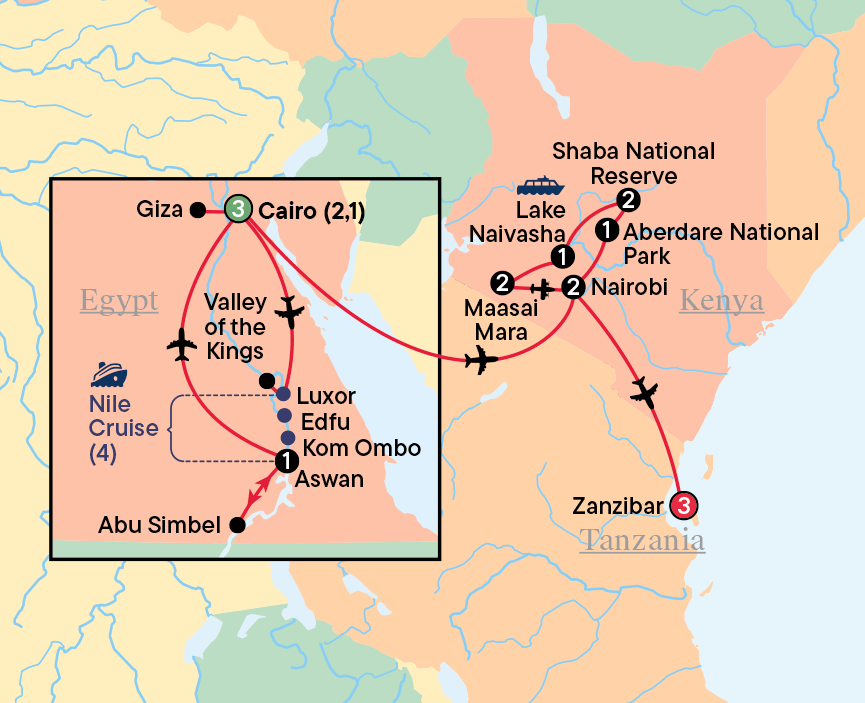
Tour map
Cairo to Zanzibar
Tour Enquiry
Cairo to Zanzibar
About the tour
Itinerary
1
Depart Australia
2
Arrive Cairo
Welcome to Egypt, a country known for its historical sites and world wonders. We begin in Cairo, the sprawling capital of Egypt and the largest city in Africa. Home to many famous Egyptian landmarks, visitors will find it to be a fascinating and often bewildering mixture of old and new. We don’t want you to miss out on any aspect of your small group tour. To ensure that you don’t, we recommend you arrive at your hotel by 6.00pm Meet your fellow travellers tonight as we enjoy a group welcome dinner. Optional Excursion Coptic Cairo - Discover the ancient sites & culture of Coptic Christians throughout Old Cairo. 3 hours – from $65pp US. Cash only. Optional Excursion Islamic Cairo - Visit the Gayer Anderson Museum, Ibn Toulon Mosque & El Sultan Hassan Mosque. 3 hours – from $65pp US. Cash only.
3
Cairo - Giza - Cairo
Our tour kicks off with a bang today! After breakfast, we begin at the oldest structures in existence and one of the Seven Wonders of the Ancient World, the amazing Great Pyramids of Giza. We'll visit the nearby Great Sphinx, with the body of a lion and the head of a king, often referred to as the national symbol of Egypt. Our tour will also take us to visit a weaving workshop, with an opportunity to purchase a locally made Egyptian carpet. Special Experience Take in the incredible views of the Great Pyramids of Giza while enjoying a delicious lunch at the 9 Pyramids Lounge. In the afternoon, our journey takes us to the brand new Grand Egyptian Museum. Construction of this architectural masterpiece commenced all the way back in 2012, and after many delays it finally partially opened to the public in October 2024. This museum is the largest archaeological museum in the world, showcasing over 100,000 antiquities. Among its treasures are the complete artifacts from the tomb of King Tutankhamun, displayed in full for the first time since their discovery in 1922. We spend the afternoon fully immersed in history as we traverse some of the 81,000m2 of floor space. We return to the hotel for an evening at leisure.
4
Cairo – Luxor – Nile Cruise
Early this morning we farewell Cairo as we transfer to the airport for our flight to Luxor. Located on the east bank of the Nile River, the city surrounds two huge, surviving ancient temples. Once the site of the ancient city of Thebes, Luxor as a whole is often considered its own open-air museum. On arrival we begin our sightseeing at the ancient Avenue of Sphinxes. This 3-kilometre-long road connects Karnak Temple and Luxor Temple. Approximately 30 pharaohs contributed to Karnak Temple’s structure over time, which explains its monumental size! Luxor Temple is home to a 25-metre-tall pink granite obelisk, which was part of a matching pair until the 1830s when one was given to France. It now stands in the centre of the Place de la Concorde in Paris. We’ll visit a local gallery to appreciate the ancient artform of papyrus craft, with an opportunity to purchase the artwork to take home. After our morning of sightseeing it’s time to embark our Nile cruise ship, ready for our four night Nile cruise. We’ll enjoy a delicious lunch on board before an afternoon at leisure indulging in the ship’s amenities, or further exploring the sites of Luxor. Optional Excursion Sound & Light Show at Karnak Temple at night. 1.5 hours – from $65pp US. Cash only.
5
Nile Cruise
It’s another early start for us this morning, leaving the ship after breakfast for a half day tour of the West Bank. Our first destination is the Valley of the Kings, a royal burial ground for many of Egypt’s pharaohs, queens and other elites. Here, we’ll discover King Tutankhamun’s Tomb, arguably the most well-known of Egypt’s pharaohs who reigned between 1332 and 1323 BC. Despite his celebrity, King Tut’s tomb is actually smaller than other royal tombs of its era, likely because of his untimely death. After descending into his tomb where his mummified body lies, we’ll enter other tombs to see examples of the elaborate and well-preserved hieroglyphic paintings. Carved deep into the limestone rock, each tomb has a similar pattern of three corridors, an antechamber and a sarcophagus chamber. Next, we explore the Temple of Hatshepsut. Built for Queen Hatshepsut, she was one of only a few women to be given the title of pharaoh. We then visit the Colossi of Memnon, a historic landmark consisting of two massive statues of the Pharaoh Amenhotep III. We’ll stop at a nearby alabaster workshop to learn how the locally quarried stone is carved and crafted, and if interested, can purchase a souvenir piece to take home. Back on board our ship, we cruise onward to Edfu, travelling through Esna Lock – an impressive engineering feat that helps control the flow of the Nile. The afternoon is at leisure before a welcome dinner on board. Optional Excursion Hot Air Balloon Ride over the West Bank in the early morning. Includes transport from hotel. 1.5 hours – from $170pp US. Cash only. Challenging Day Today is a particularly challenging day, where there will be extended periods of walking time, often across uneven ground and in areas of high altitude or heat and humidity.
6
Nile Cruise
Located on the west bank of the Nile River between Esna and Aswan lies Edfu, home to approximately 60,000 residents. This Egyptian city is renowned for the Temple of Horus, dedicated to the Falcon God, the main attraction that we'll visit this morning. This beautiful ancient temple is one of the best-preserved in Egypt and the second largest after Karnak Temple. Immerse yourself in history as you walk through the Pylon, a monumental gateway that leads you through to a spectacular courtyard framed on three sides by 32 columns. Other sites to explore here include the Inner and Outer Hypostyle Halls, the Court of Offerings, the Vestibule, the Sanctuary and more. Returning to the ship, we'll then cruise to the riverside Temple of Kom Ombo, a unique double temple that is dedicated to the gods of Sobek and Haroeris. Combining two temples into one, it is symmetrical in nature with twin entrances, two linked hypostyle halls and twin sanctuaries. As it is dedicated to Sobek, the crocodile god, it is thought that it was once teeming with crocodiles! Today we visit a Crocodile Museum which features a collection of mummified crocodiles. As we cruise to the port of Aswan this evening, we enjoy a traditional Galabeya party on board.
7
Nile Cruise
We have a very early start this morning as we cross the desert to the incredible UNESCO World Heritage-listed twin temples of Abu Simbel. The temples were originally carved out of the mountainside during the reign of Pharaoh Ramses II in the 13th century BC, as a monument to himself and his queen, Nefertari. The complex was relocated in its entirety in the 1960s to higher ground to avoid it being submerged by the Nile River due to the construction of the High Aswan Dam. We will spend a few hours exploring the temples before returning to our Nile cruise ship in Aswan. This afternoon, we’ll sail on the Nile a little bit differently – on a traditional Egyptian sailboat known as a Felucca. The Nile has been home to these simple, wooden style sailboats for thousands of years. We’ll observe life along the banks of the river as our boat takes advantage of the gentle winds and currents. Get ready for a traditional Nubian Show on board this evening. During this cultural performance we’ll witness traditional music, singers and dancers dressed in distinctive Nubian clothing, highlighting the unique culture of the Nubian people.
8
Nile Cruise – Aswan
This morning we disembark our Nile cruise ship in the Port of Aswan and bid farewell to the crew. Today will be spent exploring the incredible sights of Aswan, a historic city home to the Nubian culture and unique attractions unlike anywhere else in Egypt. On a half day tour, we visit the High Dam and the picturesque Philae Temple on Agilkia Island. Originally located on Philae Island, this temple is dedicated to Isis, the goddess of magic, who is said to have brought her husband Osiris back to life after he was killed by his own brother. Still in impeccable condition, it is remarkable to note that like Abu Simbel, this temple was also moved piece by piece to a new location to prevent flooding from the creation of the High Aswan Dam. After our morning tour, we’ll visit a local store which produces an assortment of aromatic perfumes and oils, along with ornate accessories, all available for purchase. Special Experience Navigate the waterways of the Nile to a Nubian village where we’ll visit the local market and meet a Nubian family in their home. The Nubian culture originated in what has now become modern day Sudan and southern Egypt. They have their own language, food and traditions, all of which we’ll get a taste of today. We’ll return to our hotel where the evening is at leisure. Optional Excursion Sound & Light Show at Philae Temple at night. 1.5 hours – from $65pp US. Cash only.
9
Aswan - Cairo
We’ll transfer to Aswan airport this morning for our flight back to Cairo, where we’ll have the chance to explore the city. First up, we’ll visit the 12th century Saladin Citadel of Cairo, a monumental Islamic fortification built as a defence against the crusaders in 1176 AD. We’ll see many sights inside the Citadel, including the Muhammad Ali Mosque (and no, this isn’t dedicated to the famous boxer!). Built between 1832 and 1857 by Muhammad Ali Pasha, its position and towering minarets make it one of the most prominent mosques in the Cairo skyline. Our last stop is the 14th century Khan el-Khalili Bazaar, a major souk in Cairo’s Islamic District. Famous for its handmade crafts, it’s also the perfect place to enjoy a traditional Arabic coffee. There are no fixed prices here, so make sure you practice your haggling skills! We’ll return to our hotel where the afternoon and evening is at leisure. You may wish to relax and take in the incredible Nile views from the hotel’s pool, explore the nearby shopping mall or taste some of the local cuisine – the choice is yours!
10
Cairo - Nairobi
This morning, we travel to Sakkara to see the Step Pyramid, also known as the Pyramid of Djoser. Designed by Imhotep, the famous vizier of King Djoser, this was the first pyramid ever built! Special Experience Tour the historic Serapeum of Sakkara, the burial place of the Apis Bulls The Serapeum of Sakkara was built by Ramses II between 1279 and 1213 BC as a dedication to the Greco-Egyptian God of Serapis. Before this, the area had already been used for hundreds of years as a monument for the Apis Bulls, a sacred animal believed to be the god of fertility and the underworld by the ancient Egyptians. When the site was rediscovered in 1850, they found the burial places of 64 Apis bulls and thousands of inscribed objects related to centuries of cult activity. On our tour today we’ll discover the ancient burial chambers and crypts, while learning all about the rituals and beliefs of the ancient Egyptians who called this area home. We’ll make our way to downtown Cairo to enjoy the rest of the afternoon at leisure before an early dinner at the hotel. Tonight we bid farewell to Egypt as we fly to Nairobi, the capital of Kenya, on an overnight flight.
11
Nairobi
Nairobi is the largest city between Cairo and Johannesburg. Although it is just south of the equator, it sports beautiful spring-like weather year-round – warm during the day and cool at night. It is a modern city, yet its main avenues blaze with colour from tropical bushes and vines. Less than 100 years ago, there was a river in an empty wilderness where Nairobi now stands. Despite health hazards and the ever-present danger of wild animals, Nairobi was established by 1907 and quickly grew. It also attracted world attention as the centre of big-game safaris for the rich and famous – perhaps the most famous was the safari of Teddy Roosevelt, who needed 500 porters to carry supplies! This afternoon we visit the AFEW Giraffe Centre, an important conservation initiative created by the African Fund for Endangered Wildlife. Here we can get up close whilst feeding the giraffes from an elevated platform. After lunch we’ll enjoy a visit to the Karen Blixen Museum – the former residence of famous novelist Karen Blixen. The house contains many of her original pieces along with some exhibits donated by the makers of the film, ‘Out of Africa’. Enjoy the evening at leisure to recharge after a long day.
12
Nairobi
Today we visit one of Kenya’s great conservation projects, Daphne Sheldrick’s animal orphanage at the David Sheldrick Wildlife Trust. For over 25 years, Kenyan-born Daphne Sheldrick lived and worked alongside her husband David, during which time they raised and successfully rehabilitated many wild species. Daphne Sheldrick’s involvement with wildlife has spanned a lifetime. She is now a recognised international authority on the rearing of wild creatures and is the first person to have perfected the milk formula and necessary husbandry for infant milk-dependent elephants and rhinos. Later we visit the Anselm Kitengela Hot Glass studio and enjoy a glassblowing demonstration. Here we will see how expert Kenyan artisans create functional handmade objects from recycled glass and learn about the unique art of glassblowing. During your free time for lunch here, you may wish to purchase some of the exquisite, brightly coloured masterpieces for yourself. Take some time to relax at the hotel this afternoon before our group dinner at the picturesque Fairway restaurant within the Karen Golf Club.
13
Nairobi - Aberdare National Park
Leaving Nairobi this morning, we start our journey into the Kenyan countryside. The first stop is at the Nanyuki Spinners and Weavers, a women's self-help group that produces beautiful, handcrafted items. We’ll learn about the traditional techniques used to make these items and will have the chance to purchase unique souvenirs to take home. Continuing on, we make our way to Aberdare National Park, a protected area in Kenya’s central highlands. Known for its stunning high moorland, bamboo forests and thundering waterfalls, it is home to a variety of wildlife, including elephant, buffalo, leopards and several primate species. After lunch at the Aberdare Country Club, we are transferred to our quirky ‘Ark’ accommodation. As the name suggests, the building shares some resemblance with Noah’s Ark, and is a testament to the abundant wildlife in the area. Here, we’ll enjoy the afternoon at leisure to gaze out over the floodlit waterhole and salt lick, watching the wildlife bask in this beautiful setting. For any discerning photographers in the group, we suggest a visit to the bunker – the ideal vantage point for getting the perfect shot of the wildlife which could be just metres away.
14
Aberdare National Park – Shaba National Reserve
Shaba National Reserve is our destination today, located by the banks of the Ewaso Ng’iro River in the northern part of Kenya. The river attracts a lot of wildlife thanks to its shady trees, so the likelihood of seeing a diverse range of wildlife here is even higher. We’ll check in to our accommodation, have some lunch and time to recuperate after our long drive this morning. This afternoon it’s finally time to embark on our first game drive of the tour – an experience you won’t forget in a hurry! The location of Shaba National Reserve in northern Kenya is scenically spectacular. Think waterholes and marshes, woods and grasslands, all with the imposing Shaba Hill Volcano in the background. As we make our way through the Reserve on our game drive this afternoon, we’ll be introduced to some of the unique animals in this area, including the reticulated giraffe, the largest of the giraffe subspecies, and at up to six metres height it is the tallest land animal on the planet! We’ll also be on the lookout for Grevy's zebra, Somali ostrich, beisa oryx, hippos and even “the king of the jungle”, the lion.
15
Shaba National Reserve
We have an early start for our morning game drive across Shaba’s beautiful, rugged landscape. As the sun begins to rise for the day, the animals are often out and about in the cooler temperatures and soft light, making it one of the best times of the day to spot the wildlife. We’ll continue our search for lions, buffalo, leopards and the famous 'red elephant of Samburu' – named for the red dust that coats their hides. We return to our lodge for breakfast and some downtime before taking another game drive this afternoon. After getting our wildlife fill for the day, we head to a local village. Special Experience Explore Samburu Unity Village, a women-only community, to learn about ‘a day in the life’ of a Samburu woman and her children. Formed in 2011, the Unity Village is a refuge for women looking to escape oppression, abuse and other inequities. Today it serves as a safe place for women to raise their families, educate their children and thrive in an environment where they can work together. Our experience here is magical and heartbreaking all at the same time, and you will leave with the utmost respect for these resilient women who have managed to create a better life for themselves and their children despite the hardship they have faced.
16
Shaba National Reserve – Lake Naivasha
Today we continue to Lake Naivasha, which is the highest and one of the most beautiful lakes that form part of the Great Rift Valley. Taking its name from the Maasai word En-aiposha, meaning ‘heaving’ or ‘to and fro’, the water is well-known to be turbulent in the afternoons. A popular spot for British flying boats of the 1930s, it was also the home of Joy Adamson, conservationist and the author of ‘Born Free’. After lunch we’ll take a boat safari on Lake Naivasha, in search of its residents which include over 400 bird species and numerous pods of hippo. We’ll enjoy afternoon tea at the famous Elsamere Conservation Centre, located in Joy’s former house. The museum contains a collection of her paintings and artefacts as well as memorabilia from the ‘Born Free' film, with photos documenting Joy and George Adamson's work. We then return to our lodge for dinner.
17
Lake Naivasha – Maasai Mara
After an early breakfast, we depart for the Maasai Mara. The landscape of the Maasai Mara is characterised by wide open plains and rolling grasslands, dotted with the occasional tree. The Maasai Mara flows into the Serengeti, making it one of the biggest reserves in the world. Special Experience Take a Swahili cooking class in the heart of the Maasai Mara, including a visit to the herb and vegetable garden. Whether you consider yourself a seasoned chef or complete amateur, this cooking class gives you (and your taste buds) the chance to explore the flavours and textures of traditional Swahili food. With plenty of locally sourced herbs and spices including cinnamon, turmeric, cardamom, nutmeg and more, it will be a delight for the senses. Before making our way to our accommodation, a tented camp in the Maasai Mara, we head out on a late afternoon game drive. The Maasai Mara is one of the most well-regarded wildlife reserves in Africa, and for good reason -- elephant, giraffe, eland, wildebeest, zebra and gazelle are plentiful here and commonly sighted. With a bit of luck, we may also spot a lion or cheetah.
18
Maasai Mara
We have an early start for a morning game drive to enjoy this beautiful landscape as the sun rises over the savannah. Many of the animals that call this area home are crepuscular, which means they are most active during the twilight hours. On our adventure this morning our expert guide will help us to spot the wildlife as they go about their usual business. We’ll return to the lodge for breakfast and lunch, with some time to relax. Later we’ll head out on one last safari before a special farewell dinner to farewell the Maasai Mara. Optional Excursion Maasai Mara Balloon Safari – This morning, enjoy an amazing experience as you take a balloon ride over the Maasai Mara. This is probably one of the most scenic views you will ever experience as you depart at dawn and float, suspended in a basket beneath a canopy while viewing the sights of the mighty Maasai Mara and its wildlife. On landing, you’ll be provided with a delicious bubbly-style bush breakfast. 3 hours – from $485pp US.
19
Maasai Mara – Nairobi - Zanzibar
Today is the beginning of the final phase of our journey, as we head to the airport for our flight to the exotic island of Zanzibar via Nairobi! Well known for its white sandy beaches and warm turquoise water, Zanzibar is the perfect place to relax and simply soak up the sun. Scenic fishing villages are scattered throughout the beaches of Zanzibar where the locals enjoy a simple way of life. Arriving on the island, we head to our beautiful beachside resort in Kiwengwa Beach. Located on the east coast of Zanzibar, the resort is home to impeccable white sand beaches, has over 30 acres of tropical gardens to explore, and a variety of leisure facilities to enjoy. The rest of our day is spent at leisure here indulging in whichever amenities take your fancy, before joining the group for dinner.
20
Zanzibar
The day is at leisure for you to relax and unwind in this tranquil setting or to explore more of this stunning island paradise. The choice is yours! Your tour guide or the resort staff are well equipped to provide you with any suggestions if you’re looking to get out and about. Popular activities here include visiting the beaches and reefs, caves and spice farms, or even joining a quad bike tour of the island.
21
Zanzibar
Our eyes are set on historic Stone Town, Zanzibar’s biggest city set on the opposite side of the island. A Swahili trading town, Stone Town has taken on influences from Arab, Indian and European cultures to cultivate its own unique way of life that we’ll experience today. Fans of the band Queen may also know Stone Town as the childhood hometown of the band’s charismatic lead singer, Freddie Mercury! As we begin our exploration this morning, a city tour will acquaint us with a range of different sites, including the City Market, the Anglican Church of Christ, Africa House and Forodhani Park. We’ll also visit the House of Wonders – the most significant structure on the seafront that was built in the 1880s as a ceremonial palace. Originally used as the headquarters and administrative centre during the colonial period, it was later converted into a school and a museum. Lastly, we will explore the Sultan's Palace, the Old Museum and the Old Market where we can shop for various local fruits and spices. This evening we’ll enjoy a farewell dinner at a local restaurant. We’ll indulge in the local cuisine as we reminisce on the many astounding memories we have made together over the last three weeks.
22
Depart Zanzibar
Today marks the end of our spectacular African adventure. We will enjoy our last day at leisure in paradise before transferring to the airport this evening. We hope you leave with fantastic memories!
23
Arrive Australia
Tour dates
Tour Enquiry
Cairo to Zanzibar
Tour Enquiry
Cairo to Zanzibar
Tour Enquiry
Cairo to Zanzibar
Tour Enquiry
Cairo to Zanzibar
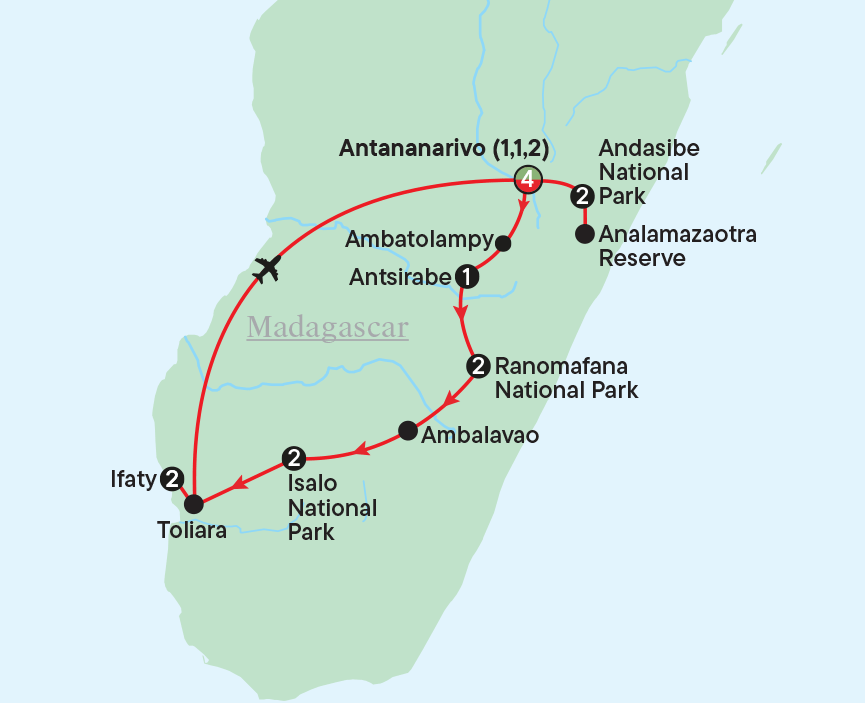
Tour map
Discover Madagascar
Tour Enquiry
Discover Madagascar
About the tour
Itinerary
1
Antananarivo
Welcome to Antananarivo, the capital and largest city of the gorgeous island nation of Madagascar. The fourth largest island in the world, Madagascar sits like a jewel in the crown of the Indian Ocean, just off the coast of Mozambique. Antananarivo is a very spread-out city and is split into upper, middle and lower town, known for its heart-shaped lake surrounded by jacaranda trees in the middle of the city centre. You will be met on arrival and transferred to your hotel. We don’t want you to miss out on any aspect of your small group tour. To ensure that you don’t, we recommend you arrive in Madagascar by 4:00 PM. This evening you will meet our local guide over a welcome dinner.
2
Antananarivo – Andasibe National Park
Today we make our way towards the eastern side of the island. and our first stop will be the Reserve Peyrieras Madagascar Exotic. This small privately run reserve at Marozevo is home to many species of reptiles found on the island, including the elusive chameleon! After a lunch stop, we continue to Andasibe National Park. We’ll go on an evening night walk in the park to discover some of the fascinating nocturnal wildlife. Known for its rich biodiversity, the Andasibe National Park is a haven for nature lovers and wildlife enthusiasts. The rainforest is home to numerous species of lemur, including the famous Indri lemur, known for its beautiful calls that echo through the forest.
3
Analamazaotra Reserve
Today, we’ll explore the Analamazaotra Special Reserve. Once part of the larger Mantadia National Park, this reserve is an absolute must-see for any nature lover! The rainforest is teeming with life—108 species of birds, 14 lemur species, and 84 types of amphibians. As we make our way through the jungle, we’ll discover exotic plants, towering trees, and even spot fascinating Madagascan reptiles. Keep your eyes peeled—if we’re lucky, we might even catch a glimpse of the legendary Indri lemur. So, get your cameras ready—this adventure is one you’ll want to remember! Special Experience Immerse yourself in the iconic Lemur Island's wildlife as you encounter these fascinating creatures up close. Challenging Day Today is a particularly challenging day, where there will be extended periods of walking time, often across uneven ground and in areas of high altitude or heat and humidity.
4
Andasibe National Park – Antsirabe
Leaving the rainforest behind this morning, we continue south along the famous Route Nationale 7, towards the town of Ambatolampy. Route Nationale 7, also known as RN7, is the primary highway running 980km through the centre of Madagascar going from the capital Antananarivo to Tulear on the country’s south-west coast. Along this road, we’ll be treated to some stunning views. At Ambatolampy, a charming little town nestled in the Madagascar highlands, we’ll get a warm welcome from the locals. These friendly villagers are known for crafting beautiful traditional pots made from recycled aluminium, and we’ll have the chance to watch them work and learn about this unique art form. It’s a great way to connect with the community and experience local craftsmanship firsthand. This afternoon, we'll make our way to the charming city of Antsirabe, famous for its colonial architecture and stunning scenery. Known as the ‘City of Water’ because of its thermal springs, Antsirabe is the perfect spot to relax, explore beautiful lakes, colourful markets, and vibrant rickshaws, all while soaking in the local culture.
5
Antsirabe – Ambositra - Ranomafana
Today’s journey takes us through the vibrant world of Madagascar’s unique handicrafts. We’ll start by exploring an eco-friendly twist on recycling in this region, understanding how locals creatively transform materials into art. Let’s dive into the colourful and crafty wonders of this amazing region. Special Experience Visit a workshop where the locals craft miniature vehicles from recycled materials and witness an informative demonstration. Next, we’ll visit a workshop where skilled artisans turn Zebu horns into beautiful souvenirs. We’ll then make our way to a shop filled with dazzling precious stones — a perfect way to discover unique local crafts and treasures. Later this morning, we’ll continue our journey south through the stunning highlands, making a stop in Ambositra, the handicraft capital of Madagascar. This town is famous for its unique Zafimaniry woodcarving, a traditional craft so special it’s been recognized by UNESCO as part of the Intangible Cultural Heritage. While there, we’ll explore local craft workshops, watch talented artisans create their masterpieces, and have the chance to pick up some beautiful souvenirs to bring home. In the late afternoon sit back, relax and enjoy the passing scenery on the way to the rainforests of Ranomafana National Park.
6
Ranomafana National Park
We’re up early this morning for an exciting adventure in Ranomafana National Park, where a park ranger and tracker will lead us on a scenic hike through the lush rainforest. As we wander through this stunning park, we’ll be surrounded by incredible wildlife, from 12 species of lemur to 115 species of birds. The variety of flora and fauna here is truly awe-inspiring, and we’ll be treated to some amazing wildlife sightings along the way. It’s a chance to immerse ourselves in Madagascar’s natural beauty and experience the magic of one of its most biodiverse parks. Following a local lunch, we'll have the afternoon at leisure to relax and unwind before we head out on an incredible nocturnal visit along the Route Nationale. With our expert guide leading the way, we'll search for nocturnal lemurs like the microcebe or mouse lemur and other nocturnal animals including chameleons. We'll then return to the lodge for a well-deserved dinner. Challenging Day Today is a particularly challenging day, where there will be extended periods of walking time, often across uneven ground and in areas of high altitude or heat and humidity.
7
Ranomafana – Ambalavao - Isalo
Today, we say goodbye to the lush Madagascan highlands and head into the dry, semi-desert landscapes of southern Madagascar. Our first stop is Ambalavao, a town renowned for its high-quality handmade silk and paper, crafted using ancient techniques. While we’re there, we’ll visit the fascinating Antemoro Paper Mill, which has a rich history that dates back to the Arab influence on the region. It’s a unique opportunity to see the traditional methods in action and learn about this centuries-old craft. The journey from the highlands to the semi-desert is just as remarkable as the stories we’ll uncover. After exploring the paper mills, we’ll enjoy a relaxing picnic lunch in the Anja Reserve. This stunning spot is managed by the local village community and is home to a variety of unique lemur species, including the iconic ring-tailed, Catta lemur. It’s the perfect place to unwind, soak in the beauty of nature, and watch these playful creatures in their natural habitat.
8
Isalo National Park
Get ready for a Jurassic-age adventure as we explore the wonders of Isalo National Park. Along the way, we’ll visit the fascinating Baras Tombs and stroll through a lush botanic garden, soaking in the stunning natural beauty all around us. Isalo’s landscapes, shaped during the Jurassic period, are unlike anything you’ve seen. The unique flora and fauna here have evolved over time to thrive in this rugged environment, making it the perfect place to step back in time and witness the incredible adaptability of life in one of Madagascar's most iconic parks. Special Experience Accompanied by a park ranger, hike through awe-inspiring canyons and oases of Isalo National Park taking in the lunar landscape. Challenging Day Today is a particularly challenging day, where there will be extended periods of walking time, often across uneven ground and in areas of high altitude or heat and humidity. After a big day, we’ll head back to the lodge for a relaxing afternoon. You can unwind by taking a dip in the swimming pool or enjoy the calming natural spring. It’s the perfect way to recharge and soak in the peaceful surroundings!
9
Isalo – Toliara - Ifaty
After breakfast we will again take the Route Nationale 7 and head towards Ifaty which is a fishing village of Vezo nomads, along the way passing through Ilakaka, a small market town of Sapphire diggers. We’ll also stop and visit the captivating Zombitse National Park. This unique park offers a fascinating mix of dry forests, marshes, and savannahs, where we’ll explore towering baobabs and get up close to the playful Sifaka dancing lemurs. Next, we’ll head to the port city of Toliara, where we’ll have some free time to explore the town and get lunch. From there, we’ll continue our journey toward the stunning shores of the Mozambique Channel. As the day winds down, we’ll make our way to the peaceful fishing village of Ifaty, a hidden gem with a gorgeous palm-fringed beach. Enjoy the tranquil surroundings and soak in the beauty of Madagascar’s coastline, drink in hand.
10
Ifaty
Early this morning, we’ll head to the Reniala Private Reserve, also known as the Baobab Forest. This magical place is home to some of Madagascar’s most iconic trees—the giant, ancient baobabs. As we stroll through the reserve, we’ll be in awe of their striking appearance and learn about their importance to the local ecosystem. The reserve is also home to a variety of unique plants and wildlife, making it a perfect spot to appreciate the natural wonders of Madagascar. It’s a fantastic opportunity to immerse ourselves in the island’s fascinating ecology. After returning to the hotel for a delicious breakfast, the rest of the day is yours to enjoy at your own pace. You can unwind and relax, taking in the peaceful atmosphere and beautiful beach of Ifaty, or head out to explore more of this colourful seaside town. Whether you choose to wander through vibrant markets, enjoy fresh seafood by the coast, or simply take in the laid-back vibes, there’s plenty to see and do in this beautiful part of Madagascar.
11
Ifaty - Toliara - Antananarivo
This morning, we say goodbye to Ifaty as we transfer to the airport for our flight back to the capital, Antananarivo. On arrival, we’ll visit the Blue Hill (or Ambohimanga). This UNESCO Heritage Site is considered the cradle of Merina Monarchy and is steeped in fascinating history and cultural significance. As we explore, we’ll dive into the rich heritage of Madagascar, learning about the ancient traditions and royal history that make this site so special. Special Experience Discover the culinary delights of Antananarivo during a lunch time cooking class. The rest of the afternoon is yours to enjoy at your own pace in Antananarivo. You could stroll through the markets, try some local cuisine, or simply take in the lively atmosphere.
12
Antananarivo
Get ready to discover Madagascar’s charming capital on a city tour this morning. One of the highlights is the Old Upper Town, perched on a granite hilltop with sweeping views of the Ikopa River Valley. Known for its impressive baroque-style palaces and gothic cathedrals, this area offers a glimpse into the city’s colonial past, with buildings dating back centuries. We’ll stroll through the city centre, soaking in the unique mix of old and new, before visiting a local craft market where you can pick up souvenirs for family and friends and also interact with artisans. Can’t get enough of Antananarivo? The afternoon is all yours to explore the city at your own pace. Whether you’re discovering hidden gems or simply sitting back and relaxing, it’s a perfect way to end our journey through breathtaking Madagascar! Tonight, we’ll enjoy a delicious group farewell dinner.
13
Antananarivo
Our tour concludes after breakfast, and we bid farewell to our new friends. You will be transferred to the airport in time for your international flight home.
Tour dates
Tour Enquiry
Discover Madagascar
Tour Enquiry
Discover Madagascar
Tour Enquiry
Discover Madagascar
Tour Enquiry
Discover Madagascar
Tour map
Georgia, Armenia & Azerbaijan
Tour Enquiry
Georgia, Armenia & Azerbaijan
About the tour
Itinerary
1
Depart Australia
2
Arrive Baku
Salam and welcome to Azerbaijan, a country with rich cultural heritage, reflected in its traditional music, dance, art and architecture. We begin in Baku, the capital and largest city of Azerbaijan, home to seaside promenades and exceptional architecture. A former soviet capital, Baku is now a fast-changing city, blending east and west into one to create a unique destination unmatched by any other. We’re in for a truly fascinating journey! We don’t want you to miss out on one moment of the incredible itinerary we have waiting for you, so we recommend you arrive at your hotel by 5.00pm. Tonight, you’ll meet your fellow travellers and Tour Director for a welcome drink, and to mingle about what you’re most looking forward to on tour.
3
Baku
Our sightseeing begins with a tour of Baku, the commercial hub of Azerbaijan. We’ll visit Martyrs’ Lane, a memorial dedicated to the victims of the 1990 Black January massacre by the Soviet Army, and the medieval-walled Old Town of Icheri Sheher. We will also explore the UNESCO World Heritage-listed 15th century Palace of the Shirvanshahs and the 12th century medieval Maiden Tower. Special Experience Savour the heart and soul of Azerbaijan’s local traditions and culture at an organic, home-made tea-cream party. Tea culture is an important social custom in Azerbaijan. Tea here is usually bright in colour and served freshly brewed, strong and in a traditional pear-shaped armudu glass, typically accompanied by sweets. We will be welcomed in for an authentic tea experience in one of the Caravanserais of the Old Town, which can be likened to a roadside rest stop that once served as a hub for shelter and refreshments for travellers. The rest of the afternoon is at leisure for you to further explore this wonderful city at your own pace, before we reconvene for dinner. Tonight, we’ll step back in time to old Baku as we enjoy a group welcome dinner with traditional live music at the Shirvanshah Museum restaurant.
4
Baku - Gobustan – Baku
Today we will embark on a fascinating exploration of primitive history as we make our way to the UNESCO World Heritage-listed Gobustan National Park, renowned for its captivating open-air museum. The park is famously home to more than 6,000 inscriptions carved into the rocks of the mountainous landscape, dating back to what is believed to be over 20,000 years ago. The petroglyphs offer an intriguing glimpse into the remnants of early human life including depictions of animals, humans, rituals and symbols. Gobustan is also recognised for its abundance of a rare geological phenomenon that bubbles up in bulbous mounds from the earth – mud volcanoes! These active volcanoes, mimicking that of a gurgling water fountain, release a combination of mud, gas and water to form a surreal terrain that is unlike anything you have likely encountered before. According to legend, the mud is thought to contain healing properties due to its high mineral content, with locals using it for a variety of medicinal purposes including joint pain. On our return to Baku, we’ll snake our way through a buzzing local bazaar, brimming with fresh seasonal produce. We then explore the Heydar Aliyev Cultural Centre, featuring a distinctive, flowing, curved style that was designed by renowned Iraqi-British architect Zaha Hadid. The museum gives an in-depth picture of Azerbaijan’s history and the life of the former president, Heydar Aliyev.
5
Baku - Sheki
Our first stop for the day is the old capital of Azerbaijan, Shamakhi. This ancient city has a rich heritage and is well known as the home of many renowned Azerbaijani scientists, philosophers and architects. Here we'll explore the Juma Mosque, built on the site of a temple of fire-worshippers. We’ll also stroll through the grounds of the Yeddi Gumbaz Seven Tombs, a complex of seven partially complete, octagonal tombs built to be used for the Shirvan royal family in the 18th century. After some free time for lunch, we’ll continue on to Sheki. This charming city was once a bustling hub for silk production and is famous for its beautifully adorned Palace of Sheki Khans. Situated 701 metres above sea level, Sheki is laid out like an amphitheatre surrounded by forests of oak trees and lofty mountains. Once we arrive, we'll visit the Yukhari Caravanserai, a historic monument originally developed as an inn for caravaners to rest after a day of travelling. Not far from Sheki is the picturesque village of Kiş where we'll discover the oldest church in the Caucasus. We’ll take in the stunning scenery as we walk through the striking foothills, before making our way back to Sheki for a group dinner.
6
Sheki - Lagodekhi - Telavi
We venture across the border into Lagodekhi, Georgia this morning. At our first stop, we'll unwind at a local winery, with a unique wine cellar that is carved into the Caucasus Mountains. Following our exploration of the interconnected tunnels that span almost 8 kilometres and provide a natural temperature for wine preservation, we will be treated to a delightful lunch accompanied by a wine tasting. Standing above the green valley of Alazin, the iconic Gremi church complex is next on our itinerary today. Founded by the King of Kakheti Levan of the Bagrationi Dynasty, who led the most prosperous and peaceful period in the history of Kakheti, this 16th century architectural monument served as a royal citadel and a church. The ruins of the church are well-preserved and offer a brilliant display of Georgian architecture. Late in the afternoon we arrive in what is considered to be Georgia’s most medieval city, Telavi.
7
Telavi
Nestled in the foothills of the Gombori Mountains, Telavi is the largest town in the heart of Georgia’s wine country. This morning we'll stop at the Bodbe Monastery, a Georgian Orthodox monastic complex where Saint Nino, the 4th century female evangelist is buried. We then continue to picturesque Sighnaghi, a town perched high on a hilltop with panoramic views of the Caucasus Mountains in the distance. Here we take a walk with our guide through this delightful, fortified town, listening in to stories of its history as we explore cobblestone streets and admire the detailed facades which gives the town its charming personality. Special Experience Visit a local family for a cooking class of dishes from the Kakheti region. Enjoy our creations for lunch with music performed by polyphonic singers. We then take a visit to Tsinandali Family Estate and wine cellar, where we will indulge in a wine tasting. Once belonging to the 19th century aristocratic poet Alexander Chavchavadze, the residence consists of a landscape garden and a historical winery, featuring several vintages of white wine. Inside the unique garden that blends European and Georgian styles, visitors will find ‘the love lane’, where legend says that if lovers can walk through the path with their eyes shut, their life together will be happy.
8
Telavi - Tbilisi
Today we depart for Tbilisi, the capital of Georgia, known for its varied culture and traditions. The city's Old Town, paved with cobblestones, is a testament to its long and complex history, including periods under both Russian and Persian rule. We will discover the sights of Tbilisi late this morning, seeing its diverse architecture and baroque and art nouveau buildings. Our sightseeing will include Metekhi Church, the Georgian Synagogue, Sulphur Baths and Rustaveli Avenue, which was named after the medieval Georgian poet, Shota Rustaveli. We’ll also ride a cable car from the Old Town up to the ancient Narikhala Fortress for breathtaking panoramic views of Tbilisi and its surrounding areas. The afternoon is at leisure for you to relax or explore more of the city at your own pace. This evening we'll experience the local culture through our taste buds at a traditional restaurant, complete with a folk show showcasing the rich history of each region in Georgia.
9
Tbilisi
After breakfast, our day is dedicated to discovering Tbilisi's hidden corners with further sightseeing in this colourful town. Stroll through the Art Nouveau Sololaki district on a walking tour, an area home to rich merchants, artists and many hidden, vintage-style cafes. As the oldest district in Tbilisi, the Sololaki district shows an authentic side to the town, with long balconies, faded paintings and echoes of its Soviet past. We’ll visit the Dry Bridge Market, where you can browse an eclectic collection of treasures ranging from jewellery and paintings to military medals, tractor parts and crystal chandeliers. Special Experience Enjoy a private, classic trio reception concert at Elene Akhvlediani Museum, complete with nibbles and an aperitif. The Elene Akhvlediani Museum pays tribute to the life and influence of the esteemed Georgian artist, Elene Akhvlediani. Set in Elene’s studio, we’ll see many of her works of art, heavily inspired by her studies in France and Italy, as well as her collection of crafts from across Georgia. In addition, we will have the opportunity to gain deeper insights into Georgian life, both past and present, with a local guest speaker who will join us at the museum.
10
Tbilisi - Kazbegi
We farewell Tibilisi this morning and continue our journey to Mtskheta, the ancient capital of Georgia. Here we explore Jvari, a UNESCO World Heritage-listed 6th century medieval monastery. It was at this site that King Mirian erected a large wooden cross after being converted by Saint Nino in the 4th century. The setting here is stunning, with vast panoramic views over the flowing rivers below. Next on our list to discover is the historic Svetitskhoveli Cathedral, another UNESCO site dating back to the 11th century. This revered cathedral is believed to be the final resting place of the Robe of Christ. We’ll take a break to drive along the beautiful mountain pass of the Georgian Military Highway to reach the Ananuri architectural complex. Originally built as a castle, the monument witnessed many battles and was ruled by the eristavis (dukes) of Aragvi feudal dynasty in the 13th century. The fortress remained in use until the 19th century and was listed on the tentative UNESCO World Heritage list in 2007. Late this afternoon, we arrive in Kazbegi, also known as Stepantsminda. Situated on the banks of the Terek River, this quaint valley town is surrounded by towering mountains, with the majestic peak of Mount Kazbek looming over it from the west.
11
Kazbegi
Grab your cameras, we’re in for some spectacular scenery today as we explore the pint-size mountain town of Kazbegi. We’ll take a short walk through the town centre before ascending by 4WD to Gergeti Trinity Church, standing at 2,200 meters above sea level. Isolated amongst the wilderness of Mount Kazbegi, the 14th century church is visible from just about anywhere in the town nestled below it – making it one of Georgia’s most iconic sights. We then drive towards the Russian border, taking in views of the granite-walled Dariali Gorge and its beautiful surroundings. Special Experience Take part in a hands-on dumpling masterclass with a local family and enjoy lunch in their home. Dumplings are a staple in Kazbegi cuisine, known to the locals as ‘khinkali’. Usually stuffed with flavour-filled spiced meat, these dumplings are typically quite large and known for their traditional pleating technique which forms a twisted ball-like shape. We’ll be welcomed into a local family’s home to get hands on and learn the culinary secrets of this delectable delicacy. The rest of the afternoon is at leisure. Why not discover more of the Caucasus Mountains by joining your guide for a hike in the dramatic Dariali Gorge? As you venture deeper into the valley, you’ll be rewarded with the magnificent sight of the gushing Gveleti waterfall. Challenging Day Today is a particularly challenging day, where there will be extended periods of walking time, often across uneven ground and in areas of high altitude or heat and humidity.
12
Kazbegi - Kutaisi
We depart Kazbegi this morning and journey to a local restaurant for lunch. Now that we’ve enjoyed some delicious flavours of the region, we venture to the centre of the Shida Kartli region, Gori, which is known as the birthplace of the infamous Soviet leader, Joseph Stalin. Here, we will visit the Stalin Museum to see the house where Stalin was born, as well as his personal railway carriage. Moving on from Gori, we will stop to explore the ancient rock-hewn ‘Fortress of God’ in the town of Uplistsikhe. Once serving as a significant religious, political and culture centre, this unique area is home to fascinating rock-cut architecture that dates backs to the 6th century BC. In some places, you can even see ancient wine barrels carved into the stone. In the evening, we will arrive in Kutaisi, the former ancient capital of the Kingdom of Colchis. Georgia’s third largest city, it is also said to be Europe’s 16th oldest city with people thought to have occupied the area from as early as the 17th century BC. Tonight, we will have the evening at leisure. Challenging Day Today is a particularly challenging day, where there will be extended periods of walking time, often across uneven ground and in areas of high altitude or heat and humidity.
13
Kutaisi
Today we'll see the sights of Kutaisi. Highlights include the Bagrati Cathedral, which is considered as the emblem of a unified Georgia. We will visit the local farmers' market, where vendors sell an array of fresh produce, including fruits, vegetables, and cheese. The next stop on the agenda is a visit to the town of Tskaltubo, to see the abandoned sanatoriums. Back in the height of the USSR, it was a well-known spa destination, popular for its therapeutic mineral waters and radon bath therapies. In the late afternoon, we'll head down into the Prometheus Caves, a 1.2 kilometre long cave complex filled with breathtaking stalactites, stalagmites, petrified waterfalls and underground rivers. Here we will enjoy a boat ride (weather permitting) on the underground lake.
14
Kutaisi - Borjomi - Vardzia
After breakfast this morning, we depart for Borjomi, which is renowned for its mineral water industry. The artesian springs in the valley here are fed by water that filters in from glaciers that sit at altitudes of up to 2,300 metres on top of the Bakuriani mountains. The water is then transported by pipes to the two bottling plants. These springs were discovered in the 1820s by the Imperial Russian military and were made famous by the Russian Empire, which in turn saw an increase in tourism to Borjomi. We’ll take a walk through the park and sample the renowned water. We continue to the Samtskhe-Javakheti region, named after two of the original Georgian tribes, Meskh and Javakhs, and considered to be the cradle of Georgian culture. On our way, we’ll take in scenery consisting of arid and stone-terraced landscapes, green valleys and centuries-old fortresses - including views of the Rabati Castle. Lastly, we’ll stop at the 10th century Khertvisi Fortress, one of the oldest in Georgia, for a photo opportunity before arriving in Vardzia in the evening.
15
Vardzia
An exciting day of discovery lies ahead of us as we visit the impressive Vardzia Cave Monastery, carved into the slopes of the Erusheti Mountain. Founded in the 12th century during the reign of Giorgi III and Queen Tamar, this fascinating complex was dug out of solid rock and became a well-fortified monastery with a significant role in Georgian history. After exploring the tunnels and chambers of the UNESCO World Heritage-listed site, we’ll enjoy some free time for lunch with some small cafes located near the complex. Special Experience Explore a nunnery in upper Vardzia, where nuns will teach us how to handcraft wooden crosses and honey wax candles. The city of Vardzia has long been considered a site of religious significance for the Georgian Orthodox Church. We will visit the upper Vardzia convent, which serves as a place of residence for the nuns who continue the rituals and traditions of the faith. Here we will try our hand at crafting wooden crosses and traditional honey wax candles. The nuns will also demonstrate how they paint symbols and showcase their handmade embroidery. Returning to the hotel, enjoy the rest of the afternoon at leisure before meeting in the evening for dinner at a local guesthouse. Challenging Day Today is a particularly challenging day, where there will be extended periods of walking time, often across uneven ground and in areas of high altitude or heat and humidity.
16
Vardzia – Yerevan
We cross the border into Armenia this morning and travel to Gyumri, known for its unique heritage and ornately carved buildings. Here we will explore Saint Astvatsatsin Church, which is also known as the 'Church of Seven Wounds' in reference to the seven sorrows of the Virgin Mary. Although the original church was built in the 7th century, it was reconstructed in 1975. Inside, we’ll enjoy a unique view of the structure’s features, including the bell tower, five separate altars and intricate markings on the stone surfaces that look similar to brush strokes. Later in the afternoon, we will arrive in Yerevan, the capital and largest city of Armenia. Perched on the banks of the Hrazdan River, Yerevan serves as the administrative, cultural and industrial centre of the country. Yerevan is also one of the world’s oldest continually inhabited cities. Enjoy some free time to unwind or discover some of the city this afternoon, before enjoying dinner at a local restaurant.
17
Yerevan - Dilijan – Lake Sevan - Yerevan
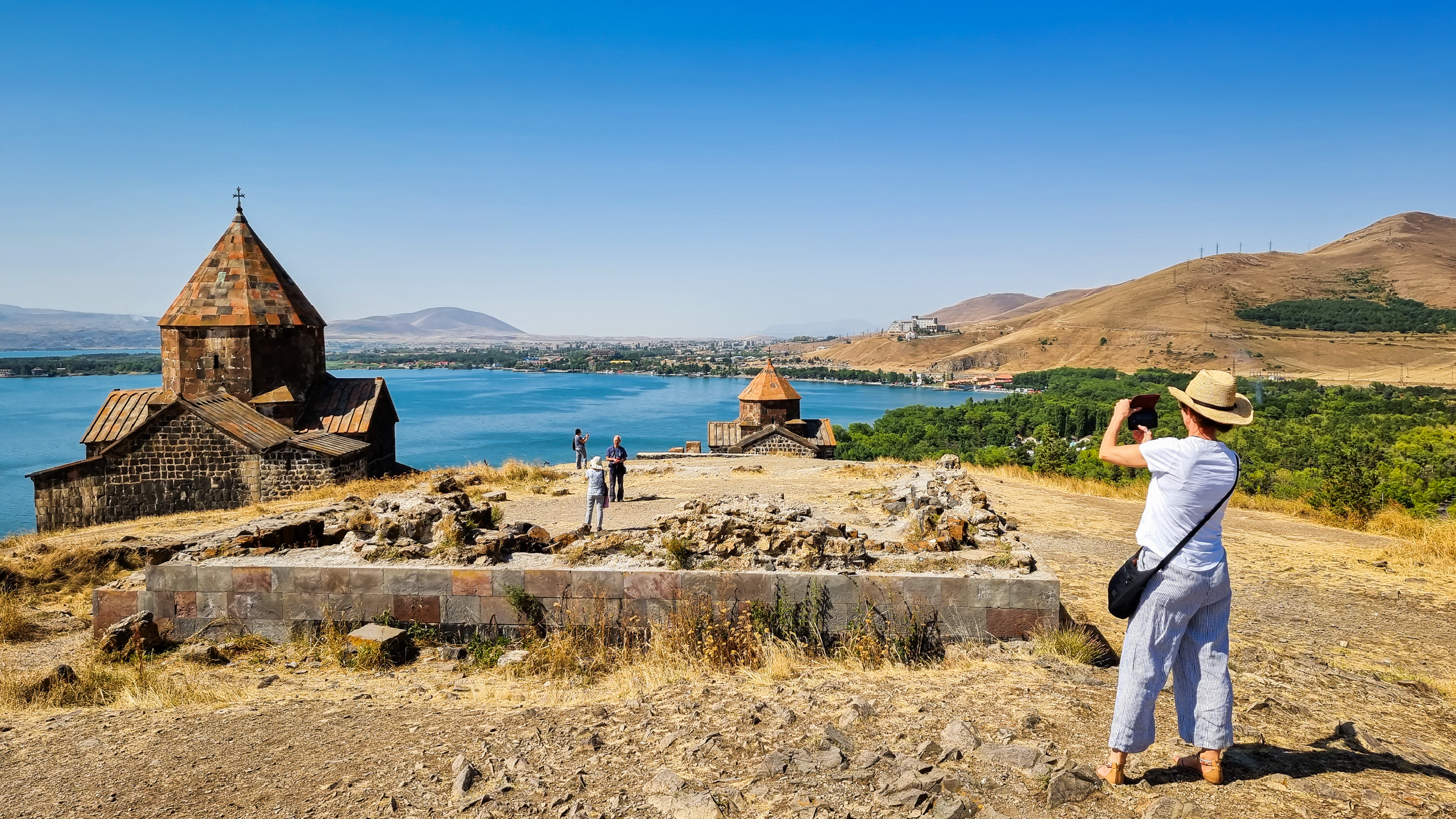
We're in for an exciting day as we make our way to the stunning Tavush Province, beginning with a visit to the town of Dilijan. As we stroll along Sharambeyan Street, adorned with traditional houses crafted from wood and stone, we'll explore some of Dilijan's craft workshops and art studios. Here we will have the opportunity to meet some local artists from the region, observe the process of wood carving and see stalls selling various khachkars, boxes, amulets and other wooden pieces. Next, we’ll explore the large basin of Lake Sevan, one of the highest freshwater lakes in the world. Interestingly, weather influences the lake’s colour, with its shades ranging from deep blue to bright azure, and every hue in-between. The lake’s water is used for hydroelectricity and irrigation purposes, providing the country with low-cost electricity. We also view Sevanavank Monastery, with spectacular vistas over the picturesque lake on the southern shore peninsula, making it one of Armenia’s most visited sights. We then visit a private residence for a fish BBQ masterclass and enjoy the creations for lunch, before returning to Yerevan. Relax this evening before more sightseeing tomorrow or spend some time strolling through the city’s centre.
18
Yerevan
We'll kick off the day with a walking tour of Yerevan, allowing us to explore this fascinating city on foot. We will discover the various layers of the town’s history, walking past medieval shrines, Republic Square, the Cascade Complex, Mother Armenia and the Opera House. Our sightseeing continues as we take a visit to the Matenadaran Museum, home to some of the oldest repositories of Greek, Persian and Arabic manuscripts. After some free time for lunch, we stop at a local Khachkar workshop. A Khachkar, also known as an Armenian cross-stone, is an outdoor memorial stele that is carved in stone by local craftspeople. Khachkars are characteristic of medieval Christian Armenian art and act as a focal point for worship. Their design includes an ornate cross in the centre, and they can reach up to 1.5 metres high. Since 2010, Khachkars have been included on the UNESCO list of Intangible Cultural Heritage. Our last stop for today is the Genocide Memorial. Built in 1967, the memorial features a 44 metre tall stele symbolising the rebirth and unity of the Armenian people. Twelve slabs are positioned in a circle, representing the twelve lost provinces in present-day Turkey. We’ll see powerful photographs, documents, reports and films dedicated to the 1.5 million people who were massacred during the first genocide of the 20th century. Enjoy the afternoon at leisure to explore at your own pace.
19
Yerevan –Khor Virap – Noravank – Areni – Yerevan
This morning we’ll discover Khor Virap, a fortified monastery and the site of the Royal Prison. It was here that Saint Gregory the Illuminator, a religious leader credited with converting Armenia from paganism to Christianity and the first bishop of the Armenian church was held for thirteen years. Guided by the remote majesty of biblical Mount Ararat, we explore the site’s underground chambers and chapels. We then continue to the Areni Cave Complex, located along the Arpa River in southern Armenia, near Areni village. This cluster of caves is where archaeologists famously unearthed the earliest ever known winery, leather shoe, straw skirt and human brain! Later we’ll indulge in a cheese masterclass, accompanied by a homemade wine and vodka tasting in the Vayots Dzor region. Situated in the heart of Armenia, this beautiful province is famous for its assortment of wine which is considered to be some of the finest in the country. On our way back to Yerevan, we’ll stop for a photo opportunity at the 13th century Armenian monastery, Noravank. Surrounded by dramatic red-hued cliffs, the complex was once home to religious leaders and the princes of the royal Orbelian family.
20
Yerevan – Garni & Geghard – Yerevan
After breakfast this morning, we’ll travel to Garni and Geghard via the picturesque Avan Canyon. With dramatic cliffs, gorges and the vast Azat River below, this canyon showcases spectacular views over the surrounding landscape. Here, we see the pagan Temple of Garni which impressively was built in the 1st century and is the only sole surviving Greco-Roman structure in the country. As we travel through the gorge, we also see the 12th century cave monastery of Geghard. Here we enjoy the harmonies of an acapella concert as five local women who form the quintet ‘Luys’ (Armenian for light), serenade us with their melodic voices. Special Experience Master the art of baking your very own lavash, a traditional Armenian flatbread. Made of simple pantry staples, lavash is a large, thin flatbread that has been enjoyed for centuries. Traditionally baked in a clay oven, this warm, soft and chewy bread is often enjoyed as a wrap or dipped into delicious stews. Learn how to prepare this sumptuous speciality and sample your creation with a side of traditional Armenian cheese and greens, the must-have accompaniments to any Armenian meal! On return to Yerevan enjoy the rest of the day at leisure before our group farewell dinner tonight.
21
Depart Yerevan
After breakfast, we bid farewell to our fellow travellers, and the beauty of Georgia, Armenia and Azerbaijan – with a heart and camera full of unforgettable memories!
22
Arrive Australia
Tour dates
Tour Enquiry
Georgia, Armenia & Azerbaijan
Tour Enquiry
Georgia, Armenia & Azerbaijan
Tour Enquiry
Georgia, Armenia & Azerbaijan
Tour Enquiry
Georgia, Armenia & Azerbaijan
Tour Enquiry
Georgia, Armenia & Azerbaijan
Tour Enquiry
Georgia, Armenia & Azerbaijan
Tour map
Türkiye In-Style
Tour Enquiry
Türkiye In-Style
About the tour
Itinerary
1
Depart Australia
2
Arrive Istanbul
Welcome to Istanbul, a city unlike any other. Spanning two continents, Istanbul straddles the Bosphorus, with one shore in Europe and the other in Asia, creating a distinctive fusion of diverse cultures. From traditional tea houses to contemporary art galleries, this compelling mix of contrasts is truly captivating. With its extraordinary blend of East and West, Istanbul offers an unforgettable journey through time and culture. We don’t want you to miss out on any aspect of your small group tour. To ensure that you don’t, we recommend you arrive at your starting destination by 5:00 pm. At 6:00pm, meet your fellow travellers and Tour Director before walking to a local restaurant for a drink and a lovely welcome dinner.
3
Istanbul
Get ready to spend a full day immersing in the incredible Istanbul. We begin our day with a visit to the Underground Basilica Cistern, the largest surviving Byzantium Cistern. Built in 532 AD during the reign of Emperor Justinian, this unique spot is truly a sight to behold with its hundreds of columns brightly lit up. We then continue to a local café that’s renowned for their traditional treats since 1864. Yum! Special Experience Excite your taste buds with some of Türkiye’s most famous delicacies, including baklava, Turkish coffee, and of course, Turkish delight! Once we’ve satisfied our taste buds, we’ll proceed to explore Istanbul’s most famous architectural wonders. First up, is the impressive domed Basilica of St. Sophia (Hagia Sophia), which has inspired architects, scholars and historians for almost 1,500 years. The first church on this site was constructed in 326 AD by Constantine the Great; the current church dates back to 537 AD and has been a cathedral, a museum, and is now a mosque. Our next destination is the Hippodrome, once the heart of the political and sporting life of the city. It was the scene of games and riots throughout 500 years of Ottoman history. We will then head to the one-of-a-kind Blue Mosque, constructed in 1609 AD under the patronage of Sultan Ahmet. As we step inside, we are consumed by the grandeur of its interior, adorned with over 20,000 exquisite Iznik tiles. These tiles, meticulously crafted with intricate patterns and varying shades of blue, narrate stories of craftsmanship and artistic brilliance that have withstood the test of time. Deluxe Experience Indulge your palate with a delightful high tea experience at the historic and iconic Pera Palace Hotel.
4
Istanbul – Gallipoli – Çanakkale
This morning, we say goodbye to Istanbul as we set our eyes on Gallipoli, our destination for the day. Today is an incredibly moving day. It is a tangible reminder of a not-so-distant past and a significant event in history that shaped Australia's national identity. Special Experience Honour the ANZACs at Gallipoli with a specialist guide, as we explore ANZAC Cove, the Lone Pine, Chunuk Bair Memorials, and Johnston's Jolly. We visit the World War I battlefields, most notable for being held by the ANZACs from 25th April to 20th December 1915, during what is referred to as The Gallipoli Campaign or Battle of Gallipoli. At the end of the war the bodies, still unburied, were cleared by the Allies on returning to the peninsula. Of the 22,000 graves at the 31 war cemeteries, only 9,000 are identified burials with grave markers. The remaining graves are commemorated with a special memorial. We’ll continue onto Çanakkale, our home for the night. Situated on the southern shore of the Dardanelles, Çanakkale is an ancient port city that has housed several civilisations over the past 6,000 years!
5
Çanakkale – Kuşadası
We start our day with a short drive to the legendary ancient city of Troy. Over its 4,000-year existence, Troy has experienced the rise and fall of nine distinct settlements, spanning from the Stone Age to the Roman Empire. If that doesn't give you goosebumps, the sight of the Trojan Horse replica at the city gates certainly will. We'll continue to explore the surroundings, including the famed city central to the Iliad, the Odyssey of Homer, and Virgil's Aeneid. Once thought to be purely mythical, these sites were unveiled as real when archaeologist Heinrich Schliemann unearthed the ruins near the modern city. Next on the agenda is the charming Greek-Turkish village of Adatepe, nestled in the foothills of the stunning Ida Mountains. We’ll delve into the rich history and traditional techniques of olive pressing and harvesting in Türkiye at the Adatepe Olive Oil Museum. We’ll also have the chance to sample some of the local produce. We’ll then continue to Kuşadası, our home for the next two nights.
6
Kuşadası – Ephesus –Şirince – Kuşadası
Our morning begins with a visit to the extraordinary UNESCO World Heritage Site of Ephesus. As the largest and most significant Roman city ever unearthed, stepping into Ephesus is like traveling back in time. Its remarkably preserved ruins span centuries of history, from classical Greece to the Roman Empire, when it served as the Mediterranean's primary commercial centre. Walking along the marble-paved streets of Ephesus offers a glimpse into daily life from those eras. We'll explore ancient gymnasiums and bathhouses, marvel at the Library of Celsus, and see the remains of the Temple of Artemis, one of the Seven Wonders of the Ancient World. We'll also visit a local leather factory, where you'll have the opportunity to watch artisans at work and purchase exquisite, handcrafted Turkish leather products. Next, we'll head to the charming and breathtaking village of Şirince. This scenic town is rich in history and culture, with its beautiful stone houses gracing the hillside, creating a truly picturesque setting. Special Experience Visit Şirince Village and learn to prepare some local culinary specialities in a hands-on cooking class. After a long day, we'll unwind with an evening at leisure upon returning to our hotel in Kuşadası. This lively coastal paradise, blessed with around 300 days of sunshine each year, offers plenty to explore. Or you can simply choose to unwind and watch the world go by at one of the town's many seafront restaurants. Challenging Day Today is a particularly challenging day, where there will be extended periods of walking time, often across uneven ground and in areas of high altitude or heat and humidity.
7
Kuşadası – Bodrum
After a leisurely morning in Kuşadası, we’ll make our way to the Karnas Vineyards, tucked away in the lush rolling hills of the Aegean Valley. Renowned for their award-winning wines produced with traditional and sustainable methods, this family-owned boutique winery is set on endless stretches of sprawling vines. A visit here will make you feel as if you’ve stepped right into a postcard! They’re known for growing several varieties of grapes, including Zinfandel, Syrah (Shiraz), Cabernet Franc and Vermentino. Deluxe Experience Sample local wines and regional snacks at Karnas Vineyards, a family-owned boutique winery, nestled in the verdant Aegean Valley. Our next stop is Bodrum , a coastal city sitting on a rugged peninsula that offers a true Mediterranean experience. This town boasts abundant bays and pristine beaches along its stunning coastline. The sparkling waters of the Aegean Sea are beyond inviting. Beautiful scenery aside, this town is bursting with history and iconic landmarks and has a rich cultural heritage to match. Plus, the cuisine found here is otherworldly – if you are a fan of seafood, prepare to find heaven in Bodrum! Arriving here, we’ll enjoy the remainder of the evening at leisure.
8
Bodrum
We will spend this morning exploring Bodrum Castle, also known as the Castle of St. Peter, a medieval waterfront fortification. Situated on a small rocky peninsula, the castle was built from 1402 AD onwards by the Knights of St. John. While here, we’ll visit the Museum of Underwater Archaeology, housed within the rooms and towers of the Bodrum Castle. This fascinating museum features artifacts from the 16th century, including remains from ancient shipwrecks. The remainder of the day is yours to explore Bodrum at your own pace. Relax at a seaside café or wander through the lively bazaars, where you’ll find everything from handmade goods to beautiful jewellery and unique souvenirs.
9
Bodrum – Cappadocia
Today we travel to the UNESCO World Heritage-listed Cappadocia. The region is renowned for its otherworldly landscapes, characterised by towering rock formations and cone-shaped fairy chimneys that have been shaped by millions of years of volcanic activity and erosion. We’ll transfer to the airport for our midday flight, via Istanbul to Cappadocia. Special Experience Stay in a luxurious cave hotel in the heart of Cappadocia, immersing in the town’s unique and mystical atmosphere. Complimenting Cappadocia’s otherworldly charm is our accommodation for the next two nights. We’ll get the chance to stay in ‘cave rooms’, an unforgettable experience that seamlessly blends together history, culture and comfort – this is a perfect way to immerse yourself in the true Cappadocia! Please note: The cave hotel is located right in the heart of Cappadocia, which dates back thousands of years. This means there are multiple flights of stairs, plenty of steps and uneven cobblestone ground to navigate. Rooms are scattered across multiple levels - they are not inside a singular building. Meeting our mobility and fitness requirements are essential. No two rooms are the same with quirky layouts that can be dimly lit. While these rooms are still comfortable remember you are staying in a cave! These are incredibly unique and a once in a lifetime experience to stay in this unforgettable location.
10
Cappadocia
For those that choose to do hot air ballooning, we have an early start this morning. Optional Excursion Hot Air Balloon Ride – Gently float over the countryside in complete harmony with the deep canyons and lush fertile valleys of Cappadocia. Gentle winds carry you over places that could never be reached except by balloon. 45mins - from Euro 340pp. Cash only. We will have time to rest before commencing with the rest of the days’ sightseeing. Our first stop of the day is the local municipality carpet cooperation where we’ll learn about this intricate and age-old artform of Turkish weaving. We continue on to explore the spectacular landscape of Göreme Valley. Over thousands of years, the rain has eroded this landscape to give rise to unique rock formations known as 'Fairy Chimneys'. Many of these formations now have homes and churches carved into them. Some of the grottoes are even magnificently decorated with colourful frescoes depicting biblical scenes. Later today, we will visit a local family where we’ll get the chance to learn about their lifestyle and the local way of life in Cappadocia. This evening we’ll enjoy dinner in a local family restaurant. Challenging Day Today is a particularly challenging day, where there will be extended periods of walking time, often across uneven ground and in areas of high altitude or heat and humidity.
11
Cappadocia – Istanbul
We begin our day by driving to the charming village of Avanos, a town famous for its centuries long tradition of pottery making and carpet weaving. While here, we’ll enjoy a lecture by locals on ceramic art. Next, we make our way to the incredible underground city of Ozkonak. Featuring a maze of tunnels, chambers and rooms carved into soft volcanic rock over ten levels, this underground city is one of the best preserved in the area. It can hold an incredible 60,000 people and is over 40 metres deep into the Earth. Today, only four of these levels are accessible by the public. It is believed that the origins of Ozkonak dates back to the fourth century BC and was greatly expanded and deepened during the Byzantine era. Later, we transfer to the airport for our flight back to Istanbul.
12
Istanbul
Get set for our final full day exploring the fascinating city of Istanbul! Our first stop of the day is a visit to the magnificent Topkapi Palace. Constructed between 1466 and 1478 AD, the Topkapi Palace served as the residence of the esteemed Sultans and their households and functioned as the primary hub of the Ottoman Empire from the 15th to the 19th centuries. Today, it is filled with treasures and antiquities, including 12000 pieces of fine Chinese porcelain. We continue our journey to the famous Grand Bazaar. Built in 1457 AD, the Grand Bazaar is one of the largest covered markets in the world. It is most famous for its antique shops, jewellery, carpets, hand-painted ceramics, embroideries and spices. We’ll also make our way to the exotic Spice Bazaar, where you’ll have some time to browse through the stalls at your leisure and soak up the scents of hundreds of spices permeating the air. Later this afternoon, we will embark on a leisurely cruise along Istanbul’s most famous waterway, the Bosphorus. Our journey will take us along both European and Asian shores, as we gently cruise past marvellous monuments and districts, including the Maiden’s Tower (Kız Kulesi), Dolmabahçe Palace, Çırağan Palace, Ortaköy, Ahmat Fethi Pasa Mansion, Ortaköy Mosque, Beylerbeyi Palace, Kuleli Military School, Arnavutköy and Bebek. It’s almost time to bid farewell to this mesmerising country, but not before we feast on a lavish spread of Ottoman cuisine at a beautiful local restaurant.
13
Depart Istanbul
Our tour concludes after breakfast this morning. We bid farewell to our amazing new friends and to the spectacular Türkiye. We hope you leave with memories of a lifetime.
14
Arrive Australia
Tour dates
Tour Enquiry
Türkiye In-Style
Tour Enquiry
Türkiye In-Style
Tour Enquiry
Türkiye In-Style
Tour Enquiry
Türkiye In-Style
Tour Enquiry
Türkiye In-Style
Tour map
Morocco In-Style
Tour Enquiry
Morocco In-Style
About the tour
Itinerary
1
Depart Australia
2
Arrive Casablanca
Welcome to Casablanca, Morocco’s largest and most modern city, made famous by the movie of the same name starring Humphrey Bogart and Ingrid Bergman. Located on the shores of the Atlantic Ocean, Casablanca is a curious mix of ancient Berber influences and modern European hustle and bustle, plus lots of cool places to enjoy the nation’s favourite drink - mint tea, of course. We don’t want you to miss out on any aspect of your small group tour. To ensure that you don’t, we recommend you arrive at your hotel by 4:00pm This evening, meet your fellow travellers and Tour Director for a delicious welcome dinner at a traditional Moroccan restaurant.
3
Casablanca
Our day is dedicated to exploring Morocco’s cosmopolitan hub, Casablanca. Originally settled by Berber tribes, Casablanca has witnessed a series of transformations throughout history, including periods of rule by the Phoenicians, Romans, and Portuguese. However, it was the French invasion in the 18th century that truly reshaped the city, laying the foundation for its modern identity that we’re familiar with today. After gaining independence in 1956, Casablanca continued to thrive, evolving into Morocco’s commercial and economic capital, retaining its diverse cultural heritage. We’ll explore the busy streets of Casablanca and acquaint ourselves with its European-influenced architecture along the Ain Diab Esplanade and in the Central Market. We will also visit the incredible Hassan II Mosque, seen by many as a symbol of Morocco’s rich cultural heritage and Islamic architecture. Completed in 1993, this mosque is the largest in Morocco and the second largest in the world! We’ll visit Rick’s Café, a romantic café inspired by the 1942 film ‘Casablanca’ and have some free time here for lunch, before we continue our tour to uncover Casablanca’s famous Art Deco architecture. Casablanca’s unique style is called ‘architecture mauresque’ or ‘Moorish architecture’ beautifully blending French Art Deco with Islamic flare. Enjoy the remainder of the day at leisure to explore at your own pace.
4
Casablanca – Meknes – Fez
This morning we say goodbye to beautiful Casablanca, with our eyes firmly set on mesmerising Fez. En route, we head north to Morocco’s smallest imperial city, Meknes. Founded in the 11th century, Meknes is quieter, smaller and more laid-back than Fez, but still has the winding narrow Medina streets and grand buildings of an imperial city. On arrival into Meknes, we’ll enjoy an orientation tour of the old city referred to as the ‘Versailles of Morocco’. We begin at the UNESCO World Heritage-listed old medina, a bustling maze of narrow streets, home to artisanal shops, traditional markets and historic buildings. The Royal Stables is next on our agenda, an architectural marvel that once housed thousands of horses, showcasing Meknes’ royal and military might. We’ll also visit Bab el Mansour Gate, one of the most beautiful gates in Morocco. Special Experience Visit a picturesque winery in Meknes delighting in the scenery while tasting locally produced wines with a delicious lunch. The hillside vineyards and the mild temperature make the Meknes region the most ideal wine-growing area. Among the most popular red grape varieties are Cabernet Sauvignon, Merlot, Syrah and Grenache. These varieties bring specific characteristics to the wines, such as fruity aromas, balanced tannin structure and great complexity.
5
Volubilis
Our adventure today takes us to the ancient archaeological site of Volubilis, one of the best-preserved sites in all of Morocco. Designated as a UNESCO World Heritage-listed site, Volubilis stands as a lasting testament to the civilisations that once thrived in the region. Its origins trace back to the 3rd century BC when it was first established as a Phoenician settlement, evolving over centuries into a thriving Roman city. Volubilis served as a pivotal administrative city for this part of Roman Africa, responsible for grain production and exports to Rome. We’ll dive into the site’s rich history through its partly excavated ruins. We return back to Fez at approximately midday, giving you the perfect opportunity to uncover the city at your own pace. Perhaps you want to take it easy and wander down the endless alleys, or you may wish to relax at the hotel. Whatever you do, the choice is yours!
6
Fez
Our day is dedicated to uncovering Morocco’s cultural and spiritual heart, Fez. Founded in the 9th century, Fez is a beautiful labyrinth of narrow laneways, bustling souks and ancient landmarks. This unique city offers visitors a glimpse into Morocco’s captivating past with its centuries-old traditions and historic atmosphere. We’ll begin our exploration by visiting the famous Medina, which was added to the UNESCO World Heritage list in 1981. Here, the narrow lanes and colourful traders make for some fantastic photo opportunities. We see the souks with the myriads of craftsmen, the famous tanneries and carpet stalls. Our sightseeing in the Medina includes the Karaouine Mosque and the fountains of Carpenter's Square. The Mosque is one of the oldest of its kind in the western Muslim world and does not allow non-Muslims to enter, so the best place to view this magnificent building is from the top of Medersa Attarine (when open). We’ll also visit the famous ancient old operation tannery, processing the hides of sheep and goat in stone vessels filled with a range of colourful dyes. Make sure you have your camera handy today! The rest of the evening is at leisure for you to explore or relax.
7
Fez – Midelt – Merzouga
Our drive to Merzouga today takes us past the town of Midelt, situated on the high plains between the Middle Atlas and the High Atlas Mountain ranges. In this quaint market town, the majority of the buildings are sand-coloured, resulting in a beautiful contrast against the imposing mountains that surround the city. Here we’ll enjoy a delicious lunch, before continuing in 4x4 jeeps to our desert camp accommodation. The town of Merzouga is often referred to as the ‘Jewel of the Sahara’ and is the gateway to the Erg Chebbi dunes. The dunes are among the largest in Morocco and measure up to 160 metres high! Deluxe Experience Experience the tranquil beauty of the Sahara Desert, staying in a luxury camp surrounded by breathtaking desertscapes. Located strategically in the middle of the big dunes of the Erg Chebi Desert, Merzouga Sandy Tents offers an unparalleled desert experience. We enjoy two nights under the stars here, having the opportunity to experience a camel ride at sunset and enjoy sunrise from the top of the golden dunes.
8
Merzouga
An early start this morning will see us marvelling at the beautiful sunrise that will illuminate the golden sands of the Sahara. Make sure you bring your camera with you, as this is an experience you’ll want to remember forever! After breakfast, we’ll depart in 4x4 jeeps deep into the Sahara Desert. Special Experience Travel to Khamlia, a small desert village, enjoying Moroccan tea and Gnaoua music with local nomads. We’ll enjoy a cup of Moroccan mint tea in a traditional home setting with local Gnaoua music as entertainment. Gnaoua music (or Gnawa music as it is also known) is quite a show, being a combination of Berber, Sufi and sub-Saharan African religious songs and rhythms combined with acrobatic dancing. Tonight, we will catch the beautiful sun as it sets over the desertscape surrounding our camp. A totally special and mesmerising sight!
9
Merzouga – Ouarzazate
This morning we’ll say goodbye to the stunning Sahara Desert and drive through the Dades Valley with its majestic sand castles and incredible rock formations that are known as ‘monkey toes’. The route through Dades Valley is often referred to as ‘the Road of One Thousand Kasbahs’, and it’s on this road that we’ll be able to view a vast valley dotted with hundreds of small oases and ancient fortifications. We continue our journey through Toudgha Gorge, a gorgeous canyon on the road to Skoura. In Skoura, we’ll enjoy lunch with a local Berber family, gaining real insight into their fascinating culture. The Berber’s are an indigenous ethnic group native to north Africa, renowned for their distinct culture, language and rich history, and their presence in Morocco dates back thousands of years. They are traditionally nomads, and still today, many Berber tribes maintain their nomadic lifestyle. Lastly, we make our way to Ouarzazate. Often called the ‘Door of the Desert’, this fortified city is nestled amid the Atlas Mountains and its caramel-coloured buildings blend almost seamlessly into the desert’s golden sand. Ouarzazate is also a noted film-making location with films such as Lawrence of Arabia, The Mummy, Gladiator and Kingdom of Heaven shot here. On arrival in Ouarzazate, the rest of the day is ours to spend at leisure.
10
Ouarzazate
Our day is dedicated to exploring Ouarzazate and the beautiful Taourirt Kasbah. Among one of the most captivating Kasbahs in Morocco, the Taourirt Kasbah’s rich history dates all the way back to the French departure in 1953. Here, we’ll immerse ourselves in the cinematic legacies of the Ouarzazate Kasbahs, where the Moroccan film industry thrived in the post-French era. We’ll also discover the allure of the famous Atlas Studios, located just 5-kilometres west of Ouarzazate. This incredible location boasts the title of the world’s largest film studio by acreage! Nestled amid the desert and mountains, this amazing studio has preserved the sets from renowned productions including Gladiator and Game of Thrones, making it a must-visit destination when in the region. We’ll return to Ouarzazate in the early afternoon, where you’ll have the remainder of the day at your leisure to explore this beautiful town some more or simply to relax.
11
Ouarzazate – Marrakesh
Saying goodbye to the beautiful city of Ouarzazate, we’ll make our way to the picturesque, fortified Berber village or ‘ksar’ of Ait Ben Haddou. This traditional mudbrick city (that dates back to the 11th century) is on the UNESCO World Heritage-list and is a striking example of the architecture of southern Morocco. Here, we enjoy a delicious lunch and a visit to the film sets of some famous Hollywood movies including Lawrence of Arabia, The Living Daylights, The Mummy and Gladiator. We’ll continue our journey to the magical ‘Rose City’ of Marrakesh. One of the four Imperial Cities of Morocco, Marrakesh was founded in the 11th century by the Berber dynasty Almoravid. It soon became the capital of the Islamic Empire that stretched as far as Spain and western Africa. During the rule of Yousef Ben Tachfine, Marrakesh was blessed with fine gardens, palaces, mosques and legendary walls, and was influenced by the Almoravid conquest of southern Spain. Morocco was colonised by the French in the 20th century and the strong influences from these countries can be felt today.
12
Marrakesh
The red royal city of Marrakesh is the real heartbeat of Morocco, set within sight of the snowy peaks of the High Atlas Mountains. Our entire day is dedicated to sightseeing here! First, we’ll visit the 16th century monument site of the Saadian Tombs which remained sealed until 1917 when they were rediscovered. The tombs are brilliantly decorated with intricate carvings, colourful tiles and Arabic scripts. We then continue on to the aristocratic Bahia Palace which functions as a Royal residence and see the Koutoubia Mosque, considered a masterpiece of Islamic architecture. We then head to Marrakesh’s main square, Jemaa el-Fnaa. Considered one of the most famous squares in Africa, this UNESCO World Heritage-listed site serves as the epicentre of the city where locals and visitors alike come to experience its lively atmosphere. We’ll also uncover Melah, the city’s old Jewish Quarter. Special Experience We'll take a cooking lesson in a beautiful Moroccan riad, then enjoy the food we’ve prepared for lunch. Our last sightseeing stop is a visit to the enchanting Jardin Marjorelle, gifted to the city by famous French fashion designer, Yves Saint Laurent. We’ll return to our hotel for some time at leisure, and to freshen up before our wonderful dinner experience. Deluxe Experience Delight in a private chef’s table experience at the renowned Azalai Uran Souk restaurant At Chef FZ ’s Private Table, dining is an intimate affair, best shared among a select few. Enter an exclusive world, where the chef’s creativity and passion for cooking awaits. Nestled in an authentic setting, you’ll experience the magic up close as FZ creates a culinary symphony before your eyes. Prepare to be captivated by the chef’s menu, a savory feast that rivals Michelin-starred experiences. Each meticulously crafted dish tells a story, tantalizing both the palate and the imagination. From delicate appetizers to beautifully presented dishes, every step is a testament to Chef FZ 's mastery and passion for culinary perfection.
13
Marrakesh
Our day is at leisure to enjoy the beautiful Kasbah and its facilities – this is a great chance for you to kick back and relax after our journey so far! Later this afternoon, we’ll come together to indulge in a grand high tea experience. Deluxe Experience Delight your taste buds in a decadent high tea at the enchanting Royal Mansour Marrakesh. Step into the charming sanctuary of Royal Mansour Marrakesh, where the world is put on hold for a moment. We’ll enjoy a relaxing afternoon tea in the beautiful La Grande Brasserie restaurant, where we will delight in delicious sweet and savoury snacks, freshly squeezed juices and tea and coffee. A blissful afternoon awaits us! Optional Excursion Hot Air Balloon Ride. Embark on an unforgettable early morning journey, drifting above the enchanting landscapes of Morocco as the sun stretches its first rays over the endless ochre dunes and the Atlas Mountains unfold beneath you. Includes return transfers, a flight of approx. 60 minutes, and a Berber breakfast. From Euro 230pp (minimum 2 people)
14
Marrakesh – Casablanca
Today we depart the idyllic Marrakesh and make our way back to the beautiful Casablanca. We’ll have the afternoon at leisure for you to wander the city at your own pace, before enjoying a lovely group farewell dinner at a local restaurant.
15
Depart Casablanca
Our tour concludes after breakfast this morning. We bid farewell to our new friends and to mesmerising Morocco. We hope you leave with the memories of a lifetime.
16
Arrive Australia
Tour dates
Tour Enquiry
Morocco In-Style
Tour Enquiry
Morocco In-Style
Tour Enquiry
Morocco In-Style
Tour Enquiry
Morocco In-Style
Tour map
Moroccan Discovery
Tour Enquiry
Moroccan Discovery
About the tour
Itinerary
1
Depart Australia
2
Arrive Casablanca
We say a huge ‘ahlan wa sahlan’ to Casablanca, Morocco’s largest and most modern city. Casablanca’s name, translating easily to ‘White House’ in Spanish was inspired by the sparking white-washed buildings of the Old Medina and is the perfect starting point for our adventure through the sights and sounds of this lively country. Hugging the coastline of the Atlantic Ocean, the port city of Casablanca acts as the commercial hub of western Morocco. Despite its growing modernity, Casablanca has thankfully managed to retain much of its traditional flare. The city’s French colonial legacy is evident throughout, with areas of the town featuring Mauresque architecture, Moorish design elements and European art deco themes — a truly fascinating mix awaits us. We don’t want you to miss out on any aspect of your small group tour. To ensure that you don’t, we recommend you arrive at your hotel by 4:00pm. This evening we’ll meet our fellow travellers and Tour Director for a welcome drink.
3
Casablanca
A full day exploring the busy streets of Casablanca awaits us today. We begin our sightseeing by acquainting ourselves with the city’s European-influenced architecture along the Ain Diab Esplanade. Lined with tall palm trees and bursting with vibrancy, this beach front promenade is popular with both local residents and tourists alike. We’ll then head to the Central Market, one of the most famed urban markets in Morocco. Highly regarded as one of Casablanca’s hidden gems, here we’ll take a peep into local life as vendors and buyers go about their day. Get ready to get lost in the strong aromas, chaotic sounds and local goods on offer here. Up next on our agenda is the iconic Hassan II Mosque, an opulent mosque that is set on an outcrop jutting out over the ocean. This 210 metre tall minaret is a major landmark for the city, and once you visit, it’s easy to understand why. It’s the largest mosque in Africa, and the second largest in the world, and interestingly, it’s one of only two mosques in Morocco that is open to non-Muslim spectators. Make sure to pay attention to the fine Moroccan artisanship on display, seen through the hand-carved stone, intricate marble floor and exquisite ceilings. After some free time for lunch, we’ll make our way to the Quartier Habous. Also known as Nouvelle Medina (New Medina), it was built in the 1930s by the French with the aim to solve a housing crisis in the city. What we’re left with today is a bustling medina that features a picturesque mix of Moroccan and European architectural styles. Tonight, we’ll enjoy a group welcome dinner at a typical Moroccan restaurant. Bring your appetite!
4
Casablanca - Essaouira
This morning we depart for Essaouira, a charming town nestled on Morocco’s Atlantic coast that was once the old Portuguese city of Mogador. The city was strengthened by a French architect who was a follower of Vauban. Combine these influences and the result is the very attractive and picturesque town it is today. Over time more and more artists have flocked to Essaouira, making it a fascinating place to visit. On arrival, the rest of the afternoon is ours to enjoy at leisure and begin acquainting ourselves with the city.
5
Essaouira
We’ll begin our day of sightseeing at the city’s port to experience the lively atmosphere as the boats come in and fish are sold. It’s one of the most animated spots in town and a spectacle not to be missed! We’ll then discover the ‘Door of the Navy’, built in year 1184 of the Hegira (Hegira is the journey of Islamic prophet Mohammed from Mecca to Yathrib/Medina which is believed to have happened in AD 622) to connect the city with the port. Place Moulay el-Hassan, and a stroll through the town’s colourful Kasbah are also on the agenda for today.
6
Essaouira - Marrakesh
Travelling inland, we make our way to the magical ‘Rose City’ of Marrakesh. Marrakesh is one of the four Imperial Cities of Morocco and was founded in the 11th century by the Berber dynasty, Almoravid. It soon became the capital of the Islamic Empire that stretched as far as Spain and western Africa. During the rule of Yousef Ben Tachfine, Marrakesh was blessed with fine gardens, palaces, mosques and legendary walls, and was influenced by the Almoravid conquest of southern Spain. Morocco was colonised by the French in the 20th century and the strong influences from these countries can be felt today. Upon our arrival into Marrakesh, we’ll enjoy an orientation tour before having some free time for lunch. Special Experience Experience the atmosphere of Marrakesh’s main square, Jemaa el-Fnaa. Pass through a wondrous mix of food, music and entertainment, getting a taste of this lively city. We’ll have the chance to enjoy a real taste of Morocco at dinner, complete with dancers and musicians in a local restaurant.
7
Marrakesh
The red royal city of Marrakesh is the real heartbeat of Morocco, set within sight of the snowy peaks of the High Atlas Mountains. Our entire day is dedicated to sightseeing here. First, we visit the 16th century monument site of the Saadian Tombs which remained sealed until 1917 when they were rediscovered. The tombs are brilliantly decorated with intricate carvings, colourful tiles and Arabic scripts. We’ll then continue to the aristocratic Bahia Palace which functions as a Royal residence and see the Koutoubia Mosque, considered a masterpiece of Islamic architecture. Its minaret is even a reference point for international architecture – the 12th century 70-metre-high tower is the prototype for Seville’s La Giralda and Rabat’s Le Tour Hassan. Our last stop is a visit to the enchanting Jardin Marjorelle, gifted to the city by famous French fashion designer, Yves Saint Laurent.
8
Marrakesh
Enjoy a late start to the morning before departing for our wonderful culinary experience today. Special Experience We'll take a cooking lesson in a beautiful Moroccan riad, then enjoy the food we’ve prepared for lunch. Moroccan cuisine is a fusion of many influences that reflects the country’s history and diverse culture. It usually incorporates fruits such as apricots, dates, and raisins, and nuts along with aromatic and distinctive spices, such as cumin, coriander, saffron, cinnamon, ginger, paprika, and turmeric. The afternoon is at leisure to further explore at your own pace. Why not shop for carpets and crafts in the city’s labyrinth of souks? Optional Excursion Hot Air Balloon Ride. Embark on an unforgettable early morning journey, drifting above the enchanting landscapes of Morocco as the sun stretches its first rays over the endless ochre dunes and the Atlas Mountains unfold beneath you. Includes return transfers, a flight of approx. 60 minutes, and a Berber breakfast. From Euro 230pp (minimum 2 people)
9
Marrakesh - Skoura
This morning, we make our way through the scenic Atlas Mountains and the twisting Tizi n’Tichka pass to the picturesque, fortified Berber village or ‘ksar’ of Ait Ben Haddou. A traditional Mud Brick city, and a striking example of southern Moroccan architecture, the town is on the UNESCO World Heritage List. We continue our travels to Ouarzazate, which is also a noted film-making location with films such as Lawrence of Arabia, The Mummy, Gladiator and Kingdom of Heaven shot here. On arrival we visit the majestic structure of the Taourirt Kasbah, a giant sandcastle that decided to get fancy. Rising from the desert in all its sunbaked glory, the cinnamon coloured walls of this ancient Berber stronghold whisper stories of ancient sultans, and once inside, the intricate carvings and colourful tiles contrast with the fortress’ rugged exterior, like a warrior with a soft side. It’s no wonder this Kasbah is considered to be among the most beautiful in Morocco! After our explorations, we continue to our guesthouse in Skoura.
10
Skoura
This morning we stop at the famous palm grove of Skoura, one of the few that is still inhabited and cultivated in Morocco. We’ll then visit 17th century wonder of Kasbah Amridil, which appears on Morocco’s 50-dirham note. Amridil is a living museum, showcasing typical life in a Kasbah over the centuries. A local pottery house is also on the agenda for today, where we’ll get to see gorgeous locally made handicrafts. After some free time for lunch, we’ll take part in a traditional calligraphy workshop with a local artisan using a typical reed pen, the traditional qalam. Here, our teacher will guide us through the mesmerizing curves of Arabic script and we have the chance to create our own ink masterpiece.
11
Skoura - Merzouga
We depart Skoura through the Dades Valley, continuing past Erfoud, on the edge of the majestic Sahara Desert. This valley is carved by the Dades River and is sprinkled with ancient kasbahs, lush palm groves and dramatic rock formations. We then make our way into the vast Erg Chebbi dunes before arriving in Merzouga. And just when we think Morocco couldn’t get any more magical, we arrive in the town of Merzouga, which is often referred to as the ‘Jewel of the Sahara’ and is the gateway to the Erg Chebbi dunes. The dunes are among the largest in Morocco and measure up to 160 metres high . Here, we’ll change vehicles to 4WD’s for the last leg of our journey to the deluxe campsite. Special Experience Immerse yourself in the serenity of desert life, spending a night in a deluxe camp nestled in the dunes of the Sahara Desert. Whilst staying overnight in the desert camp, we will be able to take in spectacular views of the natural landscape as the sun sets over the golden slopes.
12
Merzouga
An early start this morning, and an experience never to be forgotten, as we set off to witness the breathtaking sunrise over the sweeping sands of the Sahara Desert. Marvel at the changing colours of the morning as the sun rises over the dunes, before returning to the camp for breakfast. After breakfast we depart in a 4WD for Khamlia, a small desert village, where we’ll enjoy a cup of Moroccan tea in a traditional home setting with local Gnaoua music as entertainment. Gnaoua music (or Gnawa music, as it is also known) is quite a show, being a combination of Berber, Sufi and sub-Saharan African religious songs and rhythms with acrobatic dancing. We’ll also visit the mines in Memphis before continuing onto the traditional artists’ village of Tissirdmine for lunch amongst the palms. The remainder of the day is at leisure for you to relax and enjoy the Kasbah.
13
Merzouga - Fez
This morning, we cross the desert again and make our way to the small village of Midelt, driving through the spectacular wooded Middle Atlas Mountains. Midelt is a market town and former French administrative post and is also one of Morocco's principal cities for the mining of several minerals. Here, we’ll stop and enjoy lunch at a local restaurant. After lunch, sit back and enjoy the mountainous scenery this afternoon as we continue to Fez, one of the oldest Imperial Cities. Fez is also a great place to purchase beautifully decorated ceramics, make sure you barter though! Fez is arguably the symbolic heart of Morocco, set in the gentle rolling countryside of the mid Atlas Mountains. The World Heritage-listed medina of Fez el-Bali (old Fez) is one of the largest living medieval cities in the world, and its gates and walls are magnificent.
14
Fez
We spend the day discovering the sights of this unique city. This morning we visit the famous Medina, which was added to the UNESCO World Heritage list in 1981. Here the narrow lanes and colourful traders make for some fantastic photo opportunities. We see the souks with the myriads of craftsmen, the famous tanneries and carpet stalls. Our sightseeing in the Medina includes the Karaouine Mosque and the fountains of Carpenter's Square. The Mosque is one of the oldest of its kind in the western Muslim world and does not allow non-Muslims to enter, so the best place to view this magnificent building is from the top of Medersa Attarine (when open). We’ll also visit the famous ancient old operation tannery, processing the hides of sheep and goat in stone vessels filled with a range of colourful dyes. The rest of the evening is at leisure for us to get out and explore on our own, or simply enjoy the night, catching our breath and relaxing at the hotel.
15
Fez – Meknes – Volubilis – Fez
From Fez we head north to Morocco’s smallest imperial city, Meknes, founded in the 11th century. Quieter and smaller than Fez, it’s also more laid-back but still has the winding narrow Medina streets and grand buildings of an imperial city. Here, we’ll enjoy an orientation tour of the old city known as the ‘Versailles of Morocco’ and see the old medina, Royal Stables and the Bab el Mansour Gate. Next, we continue to the ancient archaeological site of Volubilis. UNESCO World Heritage-listed Volubilis is a partly excavated Roman city, developed from the 3rd century BC as a Phoenician settlement. Volubilis was a central administrative city for this part of Roman Africa, responsible for grain production and exports to Rome. Volubilis is in stark contrast to the hustle and bustle of Marrakesh’s Jemaa el-Fnaa Square. Here it is quiet and free from the hordes of locals and tourists, providing the perfect opportunity to stop and reflect whilst soaking up the impressive Roman ruins and preserved mosaics. After a guided tour, we return to Fez. Challenging Day Today is a particularly challenging day, where there will be extended periods of walking time, often across uneven ground and in areas of high altitude or heat and humidity.
16
Fez - Chefchaouen
After a morning at leisure we travel to Chefchaouen, undoubtedly one of the prettiest gems in all of Morocco. Tucked away in the Rif Mountains, Chefchaouen looks like it’s been washed in every shade of blue imaginable and wandering the streets here is like stepping into a real-life watercolour painting where every alley is a new shade of sapphire, cobalt or periwinkle. Founded in the 15th century by Moulay Ali Ben Rachid, the original settlement began as a small fortress to protect the area from attacks by Portuguese invaders. The Medina and its fountains, the Kasbah, the Great Mosque and Ras al-Ma’, the traditional water source for the town are all fascinating examples of Chefchaouen’s varied history. Upon arrival at our hotel, we’ll have some free time to relax and unwind before enjoying dinner here.
17
Chefchaouen
Today we’ll explore the town’s picturesque streets on foot. Wandering through the winding lanes and alleyways is a true photographers delight – the variety of colours from different wares and shops contrast with the vivid blue buildings. This town is also the perfect place to shop for souvenirs such as woven blankets and wool that are not commonly available elsewhere in Morocco. The rest of the day is at leisure for you to experience the delights of this stunning town at your own pace. There is an option to walk with your Tour Director towards a stunning lookout point over the town and surrounding mountains. Challenging Day Today is a particularly challenging day, where there will be extended periods of walking time, often across uneven ground and in areas of high altitude or heat and humidity.
18
Chefchaouen – Rabat
We continue to Rabat today, the capital of Morocco. While smaller than many of the other cities we’ve visited, it certainly has plenty of charm. From palm-lined boulevards in the ville nouvelle to an ancient walled medina, you’ll find less tourists but the same vibrant culture. We enjoy a city tour here, first visiting the Kasbah of the Oudayas which illustrates the Islamic and French colonial heritage of the city. We’ll also see the medina, Mohamed V Mausoleum and the iconic Hassan Tower, a 12th century minaret that overlooks the remains of a mosque. Enjoy the rest of the afternoon at leisure before our group farewell dinner at a local restaurant tonight.
19
Rabat - Depart Casablanca
Our tour concludes after breakfast this morning. We bid farewell to our new friends and to mesmerising Morocco. We hope you leave with the memories of a lifetime.
20
Arrive Australia
Tour dates
Tour Enquiry
Moroccan Discovery
Tour Enquiry
Moroccan Discovery
Tour Enquiry
Moroccan Discovery
Tour Enquiry
Moroccan Discovery
Tour Enquiry
Moroccan Discovery
Tour Enquiry
Moroccan Discovery
Tour Enquiry
Moroccan Discovery
Tour Enquiry
Moroccan Discovery
Tour map
Austria, Slovenia & Croatia Christmas Markets
Tour Enquiry
Austria, Slovenia & Croatia Christmas Markets
About the tour
Itinerary
1
Vienna
Welcome to Vienna! The Austrian capital is an elegant European city that effortlessly blends imperial grandeur with modern vibrancy, captivating visitors at every turn. Vienna’s rich cultural heritage, shaped by centuries of royalty and artistry, is reflected in its stunning architecture, which tells a fascinating story at every corner. Often ranked as one of the most liveable cities in the world, Vienna’s unique atmosphere and cultural charm are sure to leave an impression. As the home of legendary composers like Mozart, Beethoven and Strauss, their influence still echoes throughout Vienna’s world-renowned concert halls and opera houses. We don’t want you to miss out on any aspect of your small group tour. To ensure that you don’t, we recommend you arrive at your starting destination by 5.00pm. At approximately 6.00pm, join your fellow travellers and tour director for brief introductions and an orientation walk before our welcome dinner at a local restaurant.
2
Vienna
The best of Vienna is at our fingertips today as we embark on a guided walking tour. We’ll make our way through this magnificent city, admiring its Baroque architecture and visit St Stephen’s Cathedral. Here, we’ll step inside the Romanesque and Gothic cathedral known as the mother church of the Roman Catholic Archdiocese and learn more about its significant history. Our walking tour will conclude near the Schwedenplatz or “Sweden Square” where we will have free time for snacks and coffee. Make sure to try the Sachertorte, a dense chocolate sponge cake with a layer of apricot jam – it’s a proud symbol of the Austrian capital! Next, we’ll head to the Schönbrunn Palace Grounds, where we’ll experience our first Christmas market. Set against the backdrop of the palace, the market sparkles with lights, handcrafted goods and mulled wine — everything you need to get into the holiday spirit. Later, we’ll take a ride on the iconic Wiener Riesenrad, the Giant Ferris Wheel, which offers breathtaking panoramic views of the city. We’ll wrap up the day with another charming Christmas market. Take in the enchanting sights of the market – from the lights, the decorations, the stalls and of course, the Christmas tree!
3
Vienna – Maribor – Ljubljana
We cross the border into Slovenia today. It may be small, but this enchanted country is packed full of charming cities, stunning architecture and unique experiences, making a visit here truly memorable. Our first stop is the town of Maribor, where we’ll enjoy a delightful walking tour through the city’s historic heart. Next, we’ll visit the Old Vine House (Hiša Stare Trte), home to the world’s oldest fruit-bearing vine. This vine has been thriving in Maribor for over 450 years. Here, we’ll sample local wines while enjoying a selection of local produce, all amidst the rich history of this remarkable place. In the afternoon, we’ll continue our journey to Ljubljana, Slovenia’s idyllic capital city. Known for its elegant buildings, tree-lined boulevards and friendly locals, Ljubljana is truly a hidden gem. In the evening, we’ll explore another festive Christmas market. Saunter through the bright decorations and the bustling stalls as we sip on mulled wine, before some free time for dinner.
4
Ljubljana – Lake Bled – Ljubljana
Ljubljana, an increasingly popular destination for travellers to Europe, is ours to explore today. We’ll start with a walking tour, taking in some of the city’s best spots, including the Central Market, where locals sell fresh produce and unique artisanal goods. We’ll then hop on the funicular from Krek Square to Ljubljana Castle, where we’ll enjoy sweeping views of the city’s colourful rooftops and the surrounding hills. Next, we’ll head to the serene and beautiful Lake Bled. Surrounded by snow-covered forests and the iconic Bled Island with its picturesque church, the lake offers a tranquil escape. We’ll take a leisurely walk around Lake Bled, breathing in the fresh alpine air and make our way up to Bled Castle, perched high on a cliff with panoramic views over the lake. We’ll also visit the local Christmas markets, brimming with festive treats, crafts and seasonal delights. We’ll return to Ljubljana for an evening at leisure. Why not further explore the Christmas markets or find a cosy restaurant to enjoy dinner.
5
Ljubljana – Postojna – Opatija
Today, we’ll bid farewell to Ljubljana and head to Postojna, a charming town that takes its name from the white-tailed eagle, a majestic bird of prey that once nested above the town. Here, we’ll explore the remarkable Postojna Cave, a vast underground wonder that’s nearly 12 million years old. As we take a train ride through its impressive chambers and galleries, you’ll be amazed by the intricate calcite formations. Afterwards, we’ll cross the border into Croatia, one of Mediterranean’s most captivating gems. Known for its crystal-clear Adriatic waters, beautiful ancient towns, rich heritage and delectable cuisine, Croatia offers a unique charm. Our first stop will be Opatija, a picturesque coastal town once frequented by the Austro-Hungarian elite. Today, Opatija is a perfect blend of history and beauty, with elegant villas, serene parks and charming churches. Upon arrival in Opatija, we’ll enjoy an early evening walking tour of the city, including our fourth Christmas Markets. We will also make a special stop at Choco World for a delicious chocolate tasting.
6
Opatija – Zadar – Split
We’ll depart Opatija this morning and begin our journey along Croatia's stunning Adriatic coast. The drive offers breathtaking views of the sea, snow-dusted hills of the Istrian Peninsula and picturesque islands. As we pass through charming coastal villages, the majestic mountain ranges provide a striking contrast to the coastal beauty. Our first stop will be Zadar, a city where ancient Roman ruins, medieval churches and vibrant modern attractions coexist. We’ll have some free time for lunch before we embark on a guided sightseeing tour to uncover the city’s rich history. Afterward, we’ll continue our journey to Split, Croatia's second-largest coastal city. Split is lively with a dynamic cultural scene, beautiful beaches and the impressive Diocletian’s Palace, a sprawling Roman fortress now home to bustling markets, cafes and narrow stone streets. It’s the perfect blend of ancient tradition and modern energy. We’ll arrive Split this evening with time to ourselves to get acquainted with the city.
7
Split
Witness the influence of the Roman Empire as we tour Split today. We’ll visit one of the world’s most impressive Roman monuments, Diocletian’s Palace. The UNESCO World Cultural Heritage-listed site was built by Emperor Diocletian in 305 AD as a residence, fortified town and military fortress – all of which make up Split’s Old Town today. As we explore the palace’s remarkable cellars, we’ll uncover the hidden stories of centuries past, tucked away beneath its ancient stone walls. We’ll also pass by Jupiter’s Temple, marvel at the grand Peristyle courtyard and stand in awe of the majestic St. Domnius Cathedral — each offering a glimpse into the ancient grandeur of the city. After the tour, we’ll have some free time to explore Split at leisure, before making our way to a very special lunch. Special Experience Travel to Stella Croatica and enjoy a delicious three-course lunch of Croatian Christmas dishes. Enjoy the rest of the day at leisure once we return to Split. Wander through its charming narrow streets lined with local shops and cafes, or simply relax along the stunning waterfront, soaking in the vibrant atmosphere of this beautiful old town.
8
Split – Plitvice Lakes – Zagreb
This morning, we’ll leave the coastal beauty of Split behind and journey through Croatia’s captivating countryside towards the breathtaking Plitvice Lakes. As we approach this UNESCO World Heritage-listed site, you'll be awestruck by its stunning waterfalls and crystal-clear lakes. During the winter months, the freezing temperatures transform the lakes into a magical winter wonderland, with the cascading waterfalls frozen into ice formations. Depending on the weather, we’ll enjoy a peaceful walk through the lakes, taking in the serene and frosty beauty before sitting down for a delicious lunch at a local restaurant. In the afternoon, we’ll continue our journey to Zagreb, Croatia’s vibrant capital city. Nestled between the slopes of the Medvednica Mountains and the northern bank of the Sava River, Zagreb offers a unique blend of medieval charm and modern elegance. You’ll be amazed by the city’s cobblestone streets, beautiful parks and historic architecture. We arrive in Zagreb in the evening where the remainder of the day is free for you to explore the surrounds.
9
Zagreb
Walking is one of the best ways to explore Zagreb, and we’ll do just that this morning. Our guided tour includes views of some of the city’s most iconic landmarks. The famous St. Mark’s church which is known for its striking colourful roof that represents the medieval coats of arms of Croatia, Zagreb and Dalmatia. We’ll also pass by St. Catherine’s church, a stunning example of Baroque architecture and the impressive Zagreb cathedral, whose twin Gothic spires stand out against the city skyline. As we stroll through the city, we’ll also see the Parliament and Government Palace, two key buildings in Croatia’s political landscape. Each offering insight into the country’s history and governance. Special Experience Discover the craft of Croatian gingerbread making and decorate your own love heart shaped gingerbread in the centre of Zagreb. Inscribed in 2010 on the Representative List of the UNESCO Intangible Cultural Heritage of Humanity, Croatia’s gingerbread craft is steeped in tradition. After learning about the age-old methods, we’ll have some free time to explore more of Zagreb, including the city’s charming Christmas markets. This evening we’ll meet back up with our group and enjoy a farewell dinner together.
10
Depart Zagreb
Our tour concludes after breakfast this morning. We bid farewell to our new friends and to the charming wonders of Austria, Slovenia and Croatia.
Tour dates
Tour Enquiry
Austria, Slovenia & Croatia Christmas Markets
Tour map
Croatia & Slovenia
Tour Enquiry
Croatia & Slovenia
About the tour
Itinerary
1
Dubrovnik
Welcome to Croatia and the historic city of Dubrovnik situated on the country’s southern coast. Often referred to as the ‘Pearl of the Adriatic’, Dubrovnik is a treasure trove of medieval architecture and rich cultural heritage. Its ancient city walls, ramparts and bastions provide breathtaking views of the Adriatic Sea, while the UNESCO World Heritage-listed Old Town offers a captivating glimpse into centuries of history. We don’t want you to miss out on any aspect of your small group tour. To ensure that you don’t, we recommend you arrive at your starting destination around 4.00pm. At approximately 5.00pm, join your fellow travellers and tour director for brief introductions and an orientation walk before our welcome dinner. Special Experience Enjoy the warm hospitality of the locals and taste the regional cuisine at a special home-hosted dinner.
2
Dubrovnik
The stunning city of Dubrovnik welcomes us with stone buildings, deep green shutters and terracotta roof tiles. Today, we’ll embark on a walking tour of the Old Town, which will transport us back to a time when this city was home to notable poets, scholars and artists. Our tour will begin at the Pile Gate, and we’ll pass the Bell Tower Clock, Orlando’s Column, and the majestic Sponza Palace. We’ll also stop at the Dominican Monastery, where you can enjoy the serene atmosphere and stunning architecture. Next, we’ll visit the Rector’s Palace, the residence of the head of the Republic of Dubrovnik, where we’ll learn about the city’s history of governance and how natural disasters shaped its impressive architecture. Our journey will continue with a visit to the Franciscan Monastery, home to one of Europe’s oldest pharmacies, which has been operating since 1317. To cap off the day, we’ll take the cable car up Mount Srd for an unforgettable view of Dubrovnik and the Adriatic Sea. In the afternoon, you’ll have leisure time to further explore the Old Town.
3
Dubrovnik - Montenegro - Dubrovnik
After an early breakfast, we’ll set off on a breathtaking drive along the Adriatic coast, with towering cliffs and lush landscapes unfolding before us. Our destination is Montenegro, a stunning country known for its natural beauty. We’ll arrive in Kotor, a UNESCO World Heritage-listed town located in the Bay of Kotor. The Bay is the longest and deepest fjord in southern Europe, and the town is dotted with charming villages along its coastline. We’ll embark on a scenic cruise through the sparkling waters of Kotor Bay. We’ll stop at the islet of Our Lady of the Rocks, famous for its unique history and striking church. After the cruise, we’ll explore Kotor’s well-preserved medieval town. The town is home to impressive landmarks such as the Tryphon Cathedral, dedicated to the patron saint of Kotor. Following the tour, we’ll enjoy a delicious lunch at a local restaurant, sampling the flavours of Montenegro. We’ll arrive back in Dubrovnik in the evening.
4
Dubrovnik - Split
After breakfast, we’ll begin our journey towards the peaceful Bacinska Jezera, one of Croatia’s hidden gems. We’ll pause here to enjoy the tranquil beauty of the lakes and take in the scenic surroundings. This is the perfect opportunity to capture some memorable photos. Next, we’ll head to the charming coastal town of Makarska, where we’ll have free time to relax and enjoy a leisurely lunch. You can take a stroll along the waterfront or savour a meal at one of the local restaurants, soaking up the laid-back Mediterranean atmosphere. After lunch, we’ll continue our journey along the breathtaking Adriatic Coast, with view that will surely leave you in awe. Our next destination is Split, Croatia’s second-largest coastal city. Once we arrive, we’ll step back in time with a fascinating walking tour of the city. We’ll pass by Jupiter’s Temple, admire the grand Peristyle courtyard and marvel at the impressive St. Domnius Cathedral. We’ll visit Diocletian’s Palace, one of the most remarkable Roman monuments in the world. Originally built by Emperor Diocletian in 305 AD as a residence, military fortress and fortified town, the palace is now the heart of Split’s Old Town and a UNESCO World Heritage-listed site. The evening is yours to enjoy at leisure.
5
Split
Our day begins with a visit to the town of Trogir, a UNESCO World Heritage-listed town known for its medieval beauty. The town’s walls dating back to the 13th century, surround a treasure trove of Renaissance buildings and narrow cobbled streets. As we stroll through the Old Town, we’ll explore landmarks like the stunning St. Lawrence Cathedral. Built on the site of an ancient Greek temple, the cathedral’s bell tower showcases a blend of architectural styles due to its long construction period. Next, we’ll continue to Klis, a town perched on a hilltop with panoramic views of Split and the surrounding coastline. Special Experience Visit the Stella Croatica village and see their proud cultural heritage firsthand during a tour and tasting of their produce. Upon returning to Split, the rest of the day is yours to relax and explore this vibrant coastal city at your leisure.
6
Split – Plitvice - Slunj
We depart split this morning and head to the breathtaking Krka Bridge. We'll stop at Krka Skradin, a quaint town nestled at the entrance of Krka National Park. Known for its traditional stone houses, peaceful atmosphere and delicious local cuisine. It's the perfect spot to capture a quick photo of the stunning scenery around us. Next, we'll drive along the picturesque Maslenica Bridge, a striking modern landmark that spans the Novigrad Sea, offering panoramic views of the sparkling waters and rugged coastline. We'll arrive at Plitvice Lakes, a UNESCO World Heritage-listed site famous for its spectacular waterfalls and vibrant, crystal-clear lakes. Here, we'll have some free time for lunch before we dive into an afternoon walking tour of the park. Plitvice Lakes National Park is one of the oldest and most beautiful parks in Croatia, made up of stunning forestry and sixteen cascading lakes. Renowned for their range of distinctive colours, the lakes’ water changes from azure to green, grey or blue depending on the quantity of minerals in the water and the angle of sunlight. After our adventure through this natural wonder, we'll head to our hotel for a relaxing evening.
7
Slunj - Ljubljana
Today, we bid farewell to Slunj and make our way to Postojna, a picturesque town nestled in Slovenia’s Karst region. Postojna is named after the white-tailed eagle, a majestic bird that once nested high above the town, adding to its allure. Here, we’ll venture into the extraordinary Postojna Cave, one of the world’s most remarkable underground systems. Formed nearly 12 million years ago, the cave stretches for over 24 kilometres, and we’ll board a train to explore its vast chambers and galleries. As we wind our way through this natural wonder, we’ll be amazed by the intricate calcite formations. Afterward, we’ll continue our journey to Ljubljana, Slovenia’s idyllic capital. Known for its blend of Baroque and modern architecture, Ljubljana offers a peaceful and picturesque atmosphere. The city’s tree-lined streets, charming bridges, and the iconic Ljubljana Castle create an irresistible charm that has earned it a spot as one of Europe’s up-and-coming destinations. Once in Ljubljana, we’ll take a short sightseeing tour, offering glimpses of the city’s highlights. We’ll have some free time to wander through the pretty streets, explore the local cafes, or visit one of the many museums before settling in for a relaxing evening in this delightful city.
8
Ljubljana – Bled – Ljubljana
The Julian Alps have been captivating European travellers for centuries, and today, we’ll have the pleasure of experiencing their beauty up close on a day trip to Bled. Known for its serene, sapphire-toned lake, charming villages and refreshing alpine air, Bled has a way of enchanting everyone who visits. We’ll begin our day with a guided tour of the town, starting with a visit to the stunning Bled Castle. Perched high on a cliff above the lake, this medieval fortress, dating back to around 1011, offers panoramic views of the surrounding area. As we stroll through its historic halls, you’ll feel like you’ve stepped back in time. No trip to Bled would be complete without tasting its famous local specialty – the Bled Cream Cake. With its delicate layers of puff pastry, smooth custard, and fluffy whipped cream, it’s a treat you definitely won’t want to miss! Next, we’ll continue our journey through Slovenia’s picturesque villages, making our way to Bohinj. Here, we’ll visit a local farm and learn all about the region’s dairy industry. Special Experience Experience a traditional butter making demonstration at a family dairy farm and enjoy a taste of the delicious dairy products. We return to Ljubljana and have the rest of the day at leisure.
9
Ljubljana – Novo Mesto – Zagreb
This morning, we’ll make our way to the delightful town of Novo Mesto, beautifully situated on a horse-shoe bend of the Krka River. With its peaceful atmosphere, winding cobblestone streets and intimate charm, this town invites us to slow down and appreciate the simple beauty of its tranquil surroundings. Special Experience Take a relaxing cruise aboard Rudolf’s Raft, meandering past adorable buildings dotted along the riverbank, while enjoying local wine, delicious snacks and light music. Next, we travel back into Croatia and to its capital city, Zagreb, nestled between the Medvednica Mountains and the Sava River. Known for its mix of medieval charm and modern elegance, Zagreb is both the cultural and economic heart of the country. Arriving in Zagreb, we’ll get acquainted with the city during free time for lunch. In the afternoon, we’ll enjoy a guiding walking tour of Zagreb’s most iconic landmarks. We’ll pass by the colourful St. Mark’s Church, the Parliament and Government Palace and the stunning St. Catherine’s Church. Lastly, we’ll marvel at the impressive Zagreb Cathedral, with its twin Gothic spires dominating the city skyline. This evening, we’ll indulge in a three-course farewell dinner at a local restaurant.
10
Depart Zagreb
Our tour concludes after breakfast this morning. We bid farewell to our new friends and to the splendour of Croatia and Slovenia.
Tour dates
Tour Enquiry
Croatia & Slovenia
Tour Enquiry
Croatia & Slovenia
Tour Enquiry
Croatia & Slovenia
Tour Enquiry
Croatia & Slovenia
Tour Enquiry
Croatia & Slovenia
Tour Enquiry
Croatia & Slovenia
Tour Enquiry
Croatia & Slovenia
Tour Enquiry
Croatia & Slovenia
Tour Enquiry
Croatia & Slovenia
Tour Enquiry
Croatia & Slovenia
Tour Enquiry
Croatia & Slovenia
Tour Enquiry
Croatia & Slovenia
Tour Enquiry
Croatia & Slovenia
Tour map
Jewels of Dalmatia
Tour Enquiry
Jewels of Dalmatia
About the tour
Itinerary
1
Depart Australia
2
Arrive Zagreb
Welcome to Croatia, one of the sparkling jewels of the Mediterranean. Boasting an incredible coastline, stunning azure seas, well-preserved old towns and a fascinating history, our journey through Dalmatia will begin here in the city of Zagreb. The beautiful capital of Zagreb is also Croatia's largest city, situated between the southern slopes of the Medvednica Mountains and the northern bank of the Sava River. The city dates back to 1094 and architecturally is a mix of Austro-Hungarian and Socialist structures. Zagreb's colourful and historic old town is surrounded by parks and has a vibrant shopping centre, as well as numerous restaurants and cafes to enjoy for lunch and dinner. Enjoy an afternoon at leisure to get your bearings, before meeting your fellow travellers and Tour Director over a welcome drink this evening. We don’t want you to miss out on any aspect of your small group tour. To ensure that you don’t, we recommend you arrive at your hotel by 6:00pm.
3
Zagreb
We begin our adventure with a tour of beautiful Zagreb this morning. The first stop is at St Mark’s Church, which dates all the way back to the 13th century. We’ll learn about its history and have time to snap a picture of its unique roof, intricately tiled with Zagreb’s coat of arms. Next it’s onto the baroque St Catherine’s Church and the Cathedral of Zagreb. Built in the 11th century and then reconstructed following an earthquake in 1880, at 108 metres tall the Cathedral remains one of the tallest buildings in Croatia to this day. Our final stops for the day take us to the Parliament building and Government Palace, where our guide will give us some insight into the political history of Zagreb and Croatia. The afternoon is at leisure to further explore this historic city on your own before tonight’s group welcome dinner at a local restaurant. You may wish to climb to the top of Lotrščak Tower and enjoy panoramic views of Zagreb at sunset.
4
Zagreb - Sarajevo
We’ll start early today and cross the border to enter the country of Bosnia & Herzegovina, also known as the heart-shaped land. The drive through the mountains to Sarajevo is one of the most scenic in the region. On our travels we make a stop at the Tunnel of Hope, a museum dedicated to a fascinating 800-metre-long tunnel. Stretching underneath an airport runway, the Tunnel of Hope served as the link to the outside world during the 1992-95 siege where Bosnian Serb forces surrounded Sarajevo. During our visit, we will learn more about the intriguing history of how the tunnel aided the survival of those under siege. Sarajevo has been the meeting point between east and west for hundreds of years, the place where time seems to have frozen. A symbol of hospitality for centuries, Sarajevo has had many civilisations and empires pass through the city, each of them leaving their mark. Within just a few hundred metres of one another, Catholic and Orthodox churches, Mosques, and Jewish synagogues proudly stand side by side, standing the test of time and welcoming travellers. Unsurprisingly, Sarajevo has also been called the 'Jerusalem of Europe'. On arrival in Sarajevo, we’ll enjoy a panoramic view of the Sarajevo Olympic Stadium, which hosted the Winter Olympic Games back in 1984, before enjoying the evening at leisure.
5
Sarajevo
After breakfast we’ll tour this diverse city, uncovering the vibrant Turkish-style bazaar, Baščaršija, with a wonderful array of pottery, metalwork and jewellery on offer. We’ll also explore the Gazi Husrev Beg Mosque, one of the oldest and most beautiful mosques, believed to have been targeted heavily during the Bosnian War. We’ll then visit the historical Gavrilo Princip Museum where the assassination of Archduke Franz Ferdinand took place and is thought to have set off a chain of events that led to the start of World War I. Special Experience Discover the culinary delights of Sarajevo on a gourmet walking tour. Enjoy a degustation of traditional foods, relax in a typical tavern and try homemade rakija. There are many different traditional foods unique to either Sarajevo or Bosnia & Herzegovina that we’ll get to try today. Bosnian cuisine incorporates ingredients such as beef, lamb, chicken, potatoes, onions, garlic, paprika, tomatoes, peppers, beans, and an assortment of vegetables. Popular dishes include burek, cevapi, and Bosanski lonac, which is a meat and vegetable stew. The rest of the day is at your leisure to further explore this wonderful city at your own pace.
6
Sarajevo - Mostar - Dubrovnik
We bid farewell to Sarajevo this morning and travel through the spectacular gorge valley of the Neretva River to the historic town of Mostar. Mostar is the second largest city in Bosnia & Herzegovina and home to the famed Stari Most (Old Bridge). Built by the Ottomans in the 16th century, the bridge was the longest single arch constructed bridge in the world for centuries. The original bridge stood for over 400 years, before it was destroyed in the 1990s during the conflicts in the region. It was rebuilt by the European Union using most of the original stones, to its original specifications and style. It has become a rite of passage for young men from Mostar to jump from the bridge into the fast flowing and icy waters below. Whilst in Mostar, we’ll also see the remains of the Turkish quarter and have some leisure time for lunch. We’ll then cross back into Croatia and continue on to Dubrovnik, set against a backdrop of the shimmering Adriatic Sea. Built on a strong tradition of maritime trade, Dubrovnik was one of the centres developing the Croatian language and literature, and was home to many notable poets, playwrights, painters, physicists, mathematicians, and other scholars. We’ll check into our hotel before enjoying an evening at leisure.
7
Dubrovnik
This morning we'll enjoy a walking tour of Dubrovnik’s Old Town including a visit to the Rector's Palace. This palace owes its present shape to many additions and reconstructions throughout its turbulent history. It underwent various restorations and repairs due to damage by fires, explosions and earthquakes. Each architect who worked on the repairs had their own view of how the building should look. Today, this allows us to enjoy the unique mix of styles that have been blended perfectly across this monumental structure. Our tour will take us past the Bell Tower Clock and Orlando's Column. We will also see Sponza Palace, the Dominican Monastery and the Franciscan Monastery, the latter boasting one of the world's oldest pharmacies. The afternoon is yours to enjoy at leisure. For lunch why not try the local seafood, such as stewed muscles or fresh oysters. As the most popular delicacy, the seafood in Dubrovnik is always caught nearby and served fresh. Tonight, we’re treated to a beautiful sunset cruise around Dubrovnik, delighting in the opportunity to marvel at this city from a different perspective. Make sure your cameras are handy to capture the city bathed in the hues of an evening glow!
8
Dubrovnik
Enjoy a full day at leisure today. You can explore this wonderful city at your own pace, or perhaps a day of relaxation is on the agenda – whatever you do, the choice is yours!
9
Dubrovnik - Hvar
We head north along the spectacular coast to Hvar Island this morning. All along the coast, small villages occupy the thin strip of land between towering mountains and cliffs and the bright turquoise waters of the Adriatic. We’ll make a few stops in some of the picturesque towns along the way, including Baćinska Jezera. Our journey to Hvar will include a ferry ride, then we take in the views from the panoramic road on the island as we travel to Hvar town. Home to idyllic beaches and rich with cultural and historic heritage, Hvar has plenty on offer. Lined with 13th-century walls that surround ornate Gothic palaces, Hvar is a small but busy town which can host up to 20,000 people a day in peak periods. The evening is free for you to enjoy at your leisure. Why not stroll the marble-clad and traffic-free streets to take in the city’s vibrant nightlife?
10
Hvar
We’ll see some of the highlights of the beautiful island of Hvar on a walking tour this morning. We will be treated to scenic views from the Hvar Fortress, a medieval castle dating back to before 500 BC. Fans of the show Game of Thrones may recognise some of the sights we pass today, as this was the filming site for scenes in the fictional city of Meereen. We then make our way to the village of Vrisnik, ready for lunch. Special Experience Enjoy the warm hospitality of the locals and taste the regional cuisine at a special home-hosted lunch at a local family restaurant. This unique opportunity allows us to delight in a shared group lunch while getting an authentic insight into the local culture – a truly unforgettable experience. We’ll return to our hotel in the afternoon and have the remainder of the day to enjoy at leisure.
11
Hvar - Split
Boarding a ferry, this morning we continue to Split, one of the jewels of Croatia’s glittering Adriatic Coast. The largest and most important city of the Dalmatia region, Split was first settled all the way back in 639 AD! Today we’ll explore the historic inner city of Split, built around the Roman Emperor Diocletian's Palace, a UNESCO World Cultural Heritage-listed site. Set on the harbourside, our tour takes us through one of the most impressive Roman structures still around today. Commissioned by the emperor Diocletian early in the 4th century, the palace has had many additions and alterations over the years, transforming it into the bustling hub that it is today. We continue to immerse ourselves in Roman history as we see the remnants of Split's Roman heritage, its Renaissance and Gothic structures, Jupiter's Temple, the Peristyle and the Cathedral. The rest of the afternoon is then yours to enjoy at leisure. You may wish to spend time at one of the city’s stunning beaches before exploring some of the excellent dining options and buzzing nightlife in town. Your Tour Director will be able to help with some recommendations.
12
Split - Trogir - Ličko Petrovo Selo
We leave Split this morning, first continuing north along the coast to the artists' town of Trogir, where scholars from around the world gather to study and paint. Here, we’ll explore the charming Old Town and see the Romanesque-Gothic Cathedral of St Lawrence. After some free time in this charming town, it’s time to head inland! We’ll make our way towards Ličko Petrovo Selo, a small village with rich history and stunning natural surroundings only a short distance away from the famed Plitvice Lakes National Park. On this scenic drive, we’ll travel via both the Krka Bridge and the Maslenica Bridge – two impressive arch bridges offering scenic views of the villages and waterways below. After checking in to our hotel, we’ll enjoy dinner together at our hotel.
13
Ličko Petrovo Selo
After breakfast we’ll head to Plitvice Lakes to explore this stunning national park. Plitvice Lakes National Park is comprised of 16 terraced lakes surrounded by densely wooded hills. Found in the Lika region of Croatia, Plitvice Lakes National Park covers a total area of 300-square-kilometres, including the dazzling string of lakes that link together over a distance of 8-kilometres. Today we’ll enjoy a morning walk around some of the lower lakes. We’ll stroll along wooden boardwalks just above the water level, allowing us to take in the stunning colours of the different lakes as we hear the water rushing right beneath our feet. Our tour of this section of the park takes us through grottoes and caves, and to Veliki Slap, the highest waterfall at 78 metres high. While the boardwalks do make it easy to get around, make sure you wear good, comfortable shoes so you can really get the most out of our adventures today! The afternoon is free for you to explore further at your own pace or to relax and enjoy the tranquillity. If you’re feeling active, you have the option to discover more of this incredible natural phenomenon on an extended walk with your guide this afternoon. Challenging Day Today is a particularly challenging day, where there will be extended periods of walking time, often across uneven ground and in areas of high altitude or heat and humidity.
14
Ličko Petrovo Selo - Opatija
This morning we make our way to the former imperial resort town of Opatija, located on the beautiful Gulf of Kvarner. Opatija is still a popular resort destination for locals and visitors from surrounding European countries due to its constantly warm climate. Along the way we stop to visit the beautiful watermill village in Rastoke. Here the bright, turquoise water of the Slunjčica flows into the Korana River, which over time has created a series of picturesque waterfalls. After some free time for lunch, we continue to Opatija. Here we’ll take an orientation tour, with our guide pointing out the highlights of this seaside town. We’ll see picturesque gardens, historic churches, scenic views of the ocean and promenades. We’ll enjoy the remainder of the day at leisure to continue exploring at our own pace.
15
Opatija - Istrian Peninsula - Opatija
Today we have an exciting excursion to the heart-shaped Istrian Peninsula. Located in Croatia’s northwest, it is actually shared by three separate countries; both Italy and Slovenia take up a slice of this Peninsula as well! The drive will take us through many tourist resorts on our way to the village of Rovinj, renowned for its colourful, narrow streets, small squares and old palaces built in Venetian style. Stroll through the colourful streets before we make our way to Pula, a strategic port dating back to ancient Roman times. During our time here we’ll visit the Roman Amphitheatre, the sixth largest of its kind to be preserved in the world today. We’ll enjoy free time here to grab a bite for lunch. Our eyes are set back on Opatija this afternoon, where we’ll enjoy the remainder of the day at leisure.
16
Opatija - Postojna - Bled
We say goodbye to Croatia today and make our way across the border into Slovenia, with our first stop at the incredible Postojna Caves. The caves are a network of 20 kilometres of passages, galleries and chambers and the largest and most-visited show cave in Europe. This massive cave has its own distinct ecosystem and is home to the unique amphibian, the olm, also known as the human-fish. After some free time for lunch, our journey continues to Predjama, stopping for a photo opportunity of the impressive Predjama Castle, built into the mouth of a cavern. Our journey then continues into the heart of the Julian Alps and the delightful city of Bled, our destination for the next couple of days. The region around Bled is beautiful, set amongst stunning mountain peaks and brimming with forests and greenery, waterfalls and streams. Special Experience Visit the traditional Gingerbread Museum to learn the history of this honey-bread and decorate your very own gingerbread heart, a symbol of love and passion. We continue to be immersed in history as we savour traditional Slovenian fare for dinner at the museum’s adjoining restaurant.
17
Bled
Bled is ours to enjoy today during a sightseeing tour, including the town, the lakeshore and the imposing Bled Castle, perched on a cliff high above the lake. Bled Castle was first mentioned in 1011 when the German emperor Henrik II gave it to the Bishops of Brixen. The castle is now a fascinating museum and exhibition space. Next, we travel to the lake valley of Bohinj, beautifully set amidst dense woods and spectacular mountains. The journey will take us through some very old, typical Slovenian villages with gorgeous landscapes. Special Experience Visit the Alpine Dairy Farming Museum, learning about the life of herdsmen in an authentic environment and tasting the locally produced cheeses. We’ll ride a cable car to the top of Mt. Vogel where we admire the breathtaking views over Lake Bohinj and the surrounding southern Julian Alps. Enjoy some free time for lunch here amongst this Alpine wonderland. After making our way back to Bled, the rest of the day is at leisure to enjoy this picture-perfect location. Whilst exploring the Lake Bled area, make sure you stop and try a local Slovenian dish, known as the Bled Cream Cake. Made with layers of puff pastry, custard and whipped cream it’ll be hard not to go back for seconds. Many cafes offer chocolate or fruit versions of the cream cake too!
18
Bled - Ljubljana
There’s plenty of time to relax today as we enjoy a full morning of leisure in Bled. Departing after lunch, we make tracks for Vintgar Gorge where we explore the lush greenery and tranquil waters of this stunning location on a walk through the ravine. Don’t forget your camera, the scenery will truly take your breath away! Finishing our walk, we’ll journey to the picturesque Slovenian city of Ljubljana. Charming and romantic, the country’s capital is an idyllic city full of elegant buildings, tree-lined boulevards and welcoming locals. Upon arrival, we’ll take a short sightseeing tour, seeing the intricate baroque buildings of the Old Town, Town Hall, Robba's Fountain, Three Bridges, Parliament and Congress Square. The historic city centre was made a car-free zone in 2007, making it incredibly easy to explore on foot and get a real feel of the history. The evening is at leisure for you to continue exploring at your own pace! Challenging Day Today is a particularly challenging day, where there will be extended periods of walking time, often across uneven ground and in areas of high altitude or heat and humidity.
19
Ljubljana
Today we’ll enjoy a full day of leisure in the gorgeous city of Ljubljana. Perhaps you want to visit Ljubljana Castle, a castle complex that stands on Castle Hill overlooking downtown Ljubljana, or maybe you’d rather wander the many cobblestoned lanes of its car-free centre and explore the boutique stores. Today’s agenda is totally up to you!
20
Ljubljana – Novo Mesto – Zagreb
After breakfast this morning, we’ll depart for the picturesque town of Novo Mesto, situated on the bend of the Krka River. The town’s history dates all the way back to the 1300s, highlighted through the traditional architecture that hugs the riverside. Special Experience Take a relaxing cruise aboard Rudolf’s Raft, meandering past adorable buildings dotted along the riverbank, while enjoying local wine, delicious snacks and light music. Back on solid ground, we have some free time to take in the sights of Novo Mesto from a different angle. Wander through cobblestone streets, kick back at a quaint coffee shop or marvel at more of the scenery from the riverfront. Later, it’s time to make our way back to where we started, the beautiful Croatian city of Zagreb. Along the way, we stop for a photo opportunity at Otocec Castle, built on a small island in the middle of the Krka River. Back in Zagreb this evening, we’ll check into our hotel before a group farewell dinner at a local restaurant. We’ll reminisce on all the wonderful memories we’ve made over the past few weeks – a great way to end a spectacular trip.
21
Depart Zagreb
Our tour concludes after breakfast this morning, marking the completion of our adventure across the Jewels of Dalmatia. We hope you leave with fantastic memories!
22
Arrive Australia
Tour dates
Tour Enquiry
Jewels of Dalmatia
Tour Enquiry
Jewels of Dalmatia
Tour Enquiry
Jewels of Dalmatia
Tour Enquiry
Jewels of Dalmatia
Tour Enquiry
Jewels of Dalmatia
Tour Enquiry
Jewels of Dalmatia
Tour Enquiry
Jewels of Dalmatia
Tour Enquiry
Jewels of Dalmatia
Tour Enquiry
Jewels of Dalmatia
Tour Enquiry
Jewels of Dalmatia
Tour Enquiry
Jewels of Dalmatia
Tour Enquiry
Jewels of Dalmatia
Tour Enquiry
Jewels of Dalmatia
Tour Enquiry
Jewels of Dalmatia
Tour Enquiry
Jewels of Dalmatia
Tour Enquiry
Jewels of Dalmatia
Tour Enquiry
Jewels of Dalmatia
Tour map
Sri Lanka In-Style
Tour Enquiry
Sri Lanka In-Style
About the tour
Itinerary
1
Depart Australia – Arrive Negombo
Ayubowan and welcome to Sri Lanka! Affectionately known as the Pearl of the Indian Ocean, Sri Lanka is a total feast for the senses and we can’t wait to dive in headfirst. Separated from India by the Palk Strait, Sri Lanka boasts a rich history that spans centuries. Historically referred to as ‘Ceylon’, this beautiful tear-drop shaped island was officially named ‘Sri Lanka’ in 1972. Home to a rich blend of traditions and cultures, Sri Lanka has been carved by the diverse religions and ethnic groups that have thrived there for centuries. The best bit? These unique customs shift and change depending on where you are! So no matter where you go, there’s always something fascinating to discover. We’re in for a real treat! We’ll arrive in Sri Lanka’s capital city of Colombo this evening, and transfer to our gorgeous hotel nestled by the beaches of Negombo.
2
Negombo
Wake up and bask in the coastal-town-vibes of Negombo. Set alongside a picturesque lagoon and home to an impressive network of canals built in Dutch colonial times, Negombo was an important strategic outpost for the trade of cinnamon in colonial times and has been ruled at varying times by the Dutch, Portuguese and British empires. We’ll enjoy the day at leisure today to rest up and refresh from our flight before our sightseeing commences in the early evening. Special Experience Take a scenic cruise along the jungle-fringed Negombo Lagoon at sunset, before enjoying a delicious BBQ dinner. As the sun sets, keep an eye out for various colourful birds and water monitors while our boat navigates the mangrove islands. To welcome us to Sri Lanka, we’ll be treated to a scrumptious dinner of traditional and local dishes, while we enjoy the opportunity to get to know our fellow travellers!
3
Negombo – Dambulla – Sigiriya
Negombo’s fish markets are full of life and colour each morning when the fresh catch is brought in and vendors voice their prices at the top of their lungs. Buyers bargain for the best deals in what is a daily practice for the locals of this coastal town. We’ll visit the fish markets during a morning tour of Negombo; don’t wear your best shoes and have a handkerchief on hand just in case of a strong aroma (it tends to smell rather fishy)! Next, we’ll make our way to the Dambulla Caves, home to the best-preserved cave temple complex of Sri Lanka. The cave temples were built in the 1st century and the gigantic granite outcrop towers more than 160 metres above its surrounds. We explore the caves covered by ancient frescoes and their interior where over a hundred statues of Buddha (157 to be exact) are housed, some carved from the rock itself. Sri Lanka is home to no less than eight UNESCO World Heritage-listed sites, five of which are situated in what is known as the ‘cultural triangle’ that is located in the centre of the island. Neighbouring some of Sri Lanka’s most important sites and landmarks, Sigiriya is the gateway to the iconic cultural triangle and national parks. We make our way to Sigiriya and enjoy the remainder of our afternoon at leisure. Our accommodation for the next few nights is nothing short of breathtaking. This unique property features chic villas separated by beautifully designed waterways, streams and lush green meadows, perfectly blending elegance with nature. Be sure to take in the stunning views of Lion Rock from the grounds of our hotel!
4
Sigiriya
Set deep in the jungle around a large hill formed by huge sculptural granite monoliths, lies the ancient and now abandoned hermitage of Ritigala. Today the visible remains are those of a Buddhist monastic congregation that used to practice meditation in total austerity. Rarely visited by tourists, this mystical place is incredibly beautiful and unspoilt with shady forests filled with streams, pools and granite boulders leading to ruins with various meditation platforms. Lucky us – we get to spend our morning exploring this enchanting location! Our destination this afternoon is Minneriya National Park, where vast expanses of evergreen forest and scrub areas serve as the roaming grounds for elephants and sambar deer. The central feature of the park is the ancient Minneriya Tank, built in the 3rd century by King Mahasena. During the dry season from June to September, this tank is an incredible place to observe the elephants who come to bathe and graze, as well as the huge flocks of birds such as cormorants and painted storks that come to fish in the shallow waters. Here, we’ll enjoy a game drive by jeep; make sure your camera is recharged. Challenging Day Today is a particularly challenging day, where there will be extended periods of walking time, often across uneven ground and in areas of high altitude or heat and humidity.
5
Sigiriya
This morning our eyes are set on Polonnaruwa, which lies at the cultural triangle’s easternmost point and became Sri Lanka’s second capital in the 11th century after the destruction of Anuradhapura. We’ll spend our morning discovering this ancient city that was built alongside a large artificial lake and is home to well-preserved ruins of palaces, bathing pools, stupas and exquisite rock sculptures of Buddha at the Gal Vihara. We’ll also get a chance to see the ‘Quadrangle’, a fascinating group of raised-ruins that are bounded by a wall—a total archaeologist’s dream! After lunch in Polonnaruwa, we’ll return to our hotel to freshen up and take some time to relax before dinner this evening.
6
Sigiriya
Regarded as one of Sri Lanka’s most impressive sites, a visit to the famous rock fortress of Sigiriya is a must. The remains of a 5th-century fortress lie perched high atop a rock plateau, offering panoramic views over a vast plain and dense jungles. Built by King Kasyapa, an impressive 5-acre fort sat astride the rock and a city nestled at its base, but now the city is gone and the fortress is in ruins. We depart our hotel early this morning to visit Sigiriya. Braving the spiral staircase, we’ll see the 21 frescoes of female nature spirits, known as Apsaras, painted beneath an overhang about 90 metres up the rock. These frescoes are beautiful – still boasting vibrant colours even after 1,500 years. Just above them, a wall adorned with 1,000-year-old graffiti and poetry serves as a testament to visitors who recorded their impressions of the painted women. Reaching the summit after climbing 1,200 stairs, we are rewarded with breathtaking views over the Sri Lankan jungle below and intriguing remnants of a once-thriving kingdom. Special Experience Be welcomed into a quaint village near Sigiriya, exploring the community and enjoying a traditional lunch with a local family. We get acquainted with the traditions of the local family as we watch how they prepare their meals, learn some traditional cooking techniques and enjoy a delicious meal together. After lunch, we’ll enjoy the remainder of our afternoon at leisure. Our luxurious hotel features a large outdoor pool, ideal for relaxing after a day of sightseeing. Challenging Day Today is a particularly challenging day, where there will be extended periods of walking time, often across uneven ground and in areas of high altitude or heat and humidity. We get acquainted with the traditions of the local family as we watch how they prepare their meals, learn some traditional cooking techniques and enjoy a delicious meal together. Before we leave, we’ll meet staff and children from the local school and learn about the Bunnik Family’s connection to the community. We’ll enjoy the remainder of our afternoon at leisure, our luxurious hotel features a large outdoor pool, ideal for relaxing after a day of sightseeing.
7
Sigiriya – Matale – Kandy
This morning we farewell Sigiriya with our sights set on Kandy! En route, we’ll discover the impressive Coconut House, which is a wonderful opportunity to see how a local family utilises every element of a coconut tree, from extracting coconut oil to creating rope. We will also stop in Matale and visit some of the best spice plantations on the island. A large variety of spices such as cinnamon, pepper, nutmeg and precious cardamom (a relative of ginger) are grown here. We’ll be shown how some of these spices are grown and processed and will be able to purchase favourites to take home. Kandy is a truly charming town that is set around an artificial lake and nestled amidst rolling hills covered by forests and tea plantations. It’s known for housing the most important Buddhist temple in the country, the former capital of Ceylon and the last seat of the Sinhalese Kingdom is Sri Lanka’s cultural capital. Kandy’s beautiful city has a distinctive style due to the impressive colonial architecture that still survives today! On arrival, we’ll visit the Temple of the Sacred Tooth Relic. Ever since it was founded in the 16th century, it has housed one of the most sacred relics of Buddhism—a tooth of Buddha collected from his funeral pyre, which is now protected within the gold-roofed Temple of the Tooth.
8
Kandy
The stunning Royal Botanical Gardens of Peradeniya is our destination this morning. Initially a Royal Park, it became a Botanical Garden in 1821 under British rule. Here exotic crops such as coffee, tea, nutmeg, rubber and cinchona (quinine)—all of which are important to the country's economy—were first tested. The Botanical Gardens include a beautiful orchid house and a wide variety of plant species from all over the world. We’ll discover the city of Kandy on a guided tour, starting at the Queen’s Hotel, one of the oldest hotels in the country and the first to be officially established in Sri Lanka. We will also make our way to Kandy Lake, a scenic spot in the heart of the city, before making our way to the Kandy Market passing local streets en route. To finish off the day, we’re treated to a mesmerising cultural show and traditional dance performance. We’ll witness the fascinating Kandyan dance, a vibrant art form unique to Sri Lanka that involves elements of fire dancing, drumming and acrobatics. The performance has deep cultural ties, traditionally being performed only during royal ceremonies, festivals and religious events.
9
Kandy – Nuwara Eliya
The country’s main hill resort, Nuwara Eliya is the heart of Sri Lanka’s lush tea-growing region. Founded by the British explorer Samuel Baker in 1846, Nuwara Eliya was a sanctuary to the colonialists keen to escape the humidity and heat of Sri Lanka. The town was originally built with mock-Tudor houses featuring inglenook fireplaces and billiard tables, a golf course, racetrack, gentlemen's clubs and botanical gardens. Now a bustling town and the vegetable garden of Sri Lanka, it still provides a glimpse of life during the colonial heyday. The region’s temperate climate makes this the coolest area in the country. Deluxe Experience Enjoy an exclusive visit to a tea plantation, learning the tea-making process and sampling the local produce while overlooking lush tea gardens. Today we’ll visit one of the most prestigious tea plantations not only in Nuwara Eliya, but in Sri Lanka as a whole! Here we’re immersed in the entire tea making process, from handpicking the tea leaves to the different techniques that help contribute to the delicious final product. Of course, no visit would be complete without enjoying some of the produce – we’ll enjoy an exclusive tasting session overlooking the incredible vistas of the rolling tea gardens. Meandering through some of the country’s most beautiful scenery, there will be plenty of photo worthy moments during our journey. We’ll arrive at our hotel in the afternoon—an elegant colonial property that dates back to 1891—and have time to relax at the hotel before a delectable dinner this evening.
10
Nuwara Eliya
We have a full day dedicated to discovering Nuwara Eliya and its beautiful surrounds. This morning we’ll board the local train for a scenic ride to Thalawakale station, passing magnificent landscapes with every twist and turn. We stop in the main town of Nuwara Eliya and enjoy a guided tour to acquaint ourselves with historically rich city. Here we’ll discover the idyllic Gregory Lake and the busy Central Market and Bazaar, full of vendors and locals going about their day. Known as Little England, Nuwara Eliya features beautiful colonial-era architecture which we’ll have the opportunity to see on our tour – this includes the renowned Nuwara Eliya Post Office! Our journey takes us out of town, venturing further to see the spectacular St. Clair and Devon Falls that cascade down the lush green mountains of the region. Known as Little Niagara of Sri Lanka, St. Clair Falls is one of the widest falls in the country. The nearby Devon Falls was named after an English coffee planter by the name of Devon, whose plantation is situated close by. Back at our stunning accommodation, we’ll indulge in a high tea iconic to the Grand Hotel, delighting in a range of locally sourced teas and delicious finger food. The evening at leisure for you to enjoy.
11
Nuwara Eliya – Udawalawe – Yala
We make our way to Yala this morning, stopping to witness the gushing water of the incredible waterfalls at Ella before continuing to Udawalawe en route. Special Experience Visit the incredible Elephant Transit Home in Udawalawe and learn about its extensive rehabilitation program. Established in 1995, the Elephant Transit Home rehabilitates orphaned elephant calves until they’re strong enough for release back into the wild. This special place is situated on the western border of Udawalawe National Park, where the elephants get the opportunity to roam free. Best job ever? Very well could be! Although we can’t get up close and personal with the elephants, we’ll be able to see plenty of adorable calves being fed during feeding time. Waving goodbye to our new elephant friends, we make our way to one of Sri Lanka’s most premier eco-tourism destinations, Yala National Park—the gateway to some of the island’s incredible wildlife. Established in 1938, Yala National Park boasts a diverse range of habitats, including scrub jungle, brackish lagoons, lakes, and rivers, that leopards, elephants, wild buffalo and more call home.
12
Yala National Park
This morning we’ll enjoy time at leisure to relax and enjoy our hotel’s facilities. Grab your cameras, we’re heading out on an incredible safari this afternoon through Yala National Park! Among the oldest and best known of Sri Lanka’s national parks, our safari will take us through the park’s stunning scenery and past a number of important cultural ruins. Think vast grassland terrain mixed with beautiful, open lagoons and water holes that are popular among the diverse species found here. Keep your eyes peeled and get your lens ready to capture the numerous different species that call this park home. From the unique Sri Lankan sloth bear and wild water buffalo to the majestic Sri Lankan elephants that roam the area, there is magic to be found with every twist and turn. Here, you’ll also get the opportunity to spot the elusive Sri Lankan leopard. Affectionately known as the Lords of the Jungle, Yala National Park has a leopard density that’s higher than anywhere else on the planet. Fingers crossed we can spot one!
13
Yala – Weligama – Galle
Farewelling the lush greenery of Yala this morning, we make our way to the coastal walled city of Galle, the capital of the South Province. Built by the Portuguese in the late 16th century, this old trading port was further fortified by the Dutch and British colonialists. The narrow streets of shuttered mansions and churches protected by the stone walls, bastions and ramparts, are a delight to stroll through. Deluxe Experience Spend two days staying a short walk from the historic walled city of Galle, wandering the narrow streets and the UNESCO World Heritage-listed Galle Fort. On arrival in Galle, we’ll enjoy a guided tour of the city on foot, learning about the town’s history and immersing in its stunning colonial architecture. We will discover the UNESCO World Heritage-listed Galle Fort, a fantastically preserved colonial sea fortress and Galle’s best-known site. Early this afternoon, we make our way to the seaside village of Habaraduwa to visit a special turtle hatchery. Set up to conserve Sri Lanka’s turtle population, we’ll get the chance to see baby turtles before they’re released into the wild. We then make our way to the stunning town of Weligama, where we’ll witness the unique stilt fishermen of Weligama go about their trade—bring your camera, this makes for a cool photo opportunity!
14
Galle
This morning we enjoy a scenic cruise along the Madu River, meandering through islets forested with mangroves. Look out for the 46 different species of birds that reside in the area, including 14 aquatic varieties, as well as huge water lilies and colourful butterflies. We’ll then visit the Moonstone Mine in Meetiyagoda. This mine is one of the few places where the semi-precious stone is found in high concentrations, hence the villagers believe this area is blessed by the moon. At Meetiyagoda you can see, or even go down into the deep, narrow shafts where the stones are mined. On our way back to the hotel, we will make a stop at the moving Tsunami Photograph Museum which remembers the devastating 2004 Boxing Day Tsunami that inflicted widespread damage to the coast of Sri Lanka. The rest of the afternoon is ours to enjoy at leisure. You may like to make the most of the luxurious hotel amenities, explore the Galle fort further on your own or take part in an optional cycling tour of Galle’s countryside—the choice is yours! Optional Excursion Cycle in the Galle Countryside - Enjoy a relaxed cycle through paddy fields and small villages stopping to meet some of the locals along the way. The tour will also include a visit to a local tea and cinnamon factory, where of course you’ll enjoy a tasting! 3 hours/30km – from US $60pp
15
Galle – Colombo
Sri Lanka’s capital Colombo, the ‘Garden City of the East’, faces the Indian Ocean and stretches along more than 14 kilometres of the island’s western shores. A bustling city crowded with buses and minivans has overtaken the once quiet roads laden with bullock carts. Tree-lined boulevards, colonial buildings, open air markets, temples, lakes, and churches add great character to this city. Upon arrival in Colombo, we’ll enjoy a guided city tour, including a visit to the Gangarama Temple and the famous Cricket Club Café, a prominent establishment in town owned by two Australians. Special Experience Navigate the hustle and bustle of Colombo’s streets during a tour of the city in open-top Jeeps. One of the most immersive tours you can take of Colombo awaits us this evening. Feel the breeze in your hair as open-top jeeps whiz us around the energetic city, discovering the lively ocean-front promenade ‘Galle Face Green’ before heading to Colombo Fort and Pettah, a busy market area that seamlessly combines colonial and local influences. We’ll visit Beira Lake, a beautiful manmade lake in the city’s centre, and uncover some of Colombo’s iconic modern landmarks, including the Old Parliament, Lotus Tower and Galbokka Lighthouse. We’ll enjoy a farewell dinner this evening at Colombo’s Gallery Café. Housed in the former offices of world-renowned Sri Lankan architect, the late Geoffrey Bawa, the internationally acclaimed restaurant is the perfect place to enjoy our last group meal together.
16
Depart Colombo
Today marks the completion of our adventure across amazing Sri Lanka. We’ll enjoy the day at leisure to explore Colombo further or simply relax and enjoy our hotel amenities. We hope you leave with fantastic memories! Optional Excursion Optional Excursion – Visit the Bunnik Tours office – Enjoy a behind the scenes tour of the Bunnik Tour’s Colombo office to see how our tours are created and meet the Sri Lankan team. Be taken on a tour of the building before enjoying a local homemade meal with the staff over lunch. 2.5 hours – complimentary
17
Arrive Australia
Tour dates
Tour Enquiry
Sri Lanka In-Style
Tour Enquiry
Sri Lanka In-Style
Tour Enquiry
Sri Lanka In-Style
Tour Enquiry
Sri Lanka In-Style
Tour Enquiry
Sri Lanka In-Style
Tour Enquiry
Sri Lanka In-Style
Tour Enquiry
Sri Lanka In-Style
Tour Enquiry
Sri Lanka In-Style
Tour Enquiry
Sri Lanka In-Style
Tour Enquiry
Sri Lanka In-Style
Tour Enquiry
Sri Lanka In-Style
Tour Enquiry
Sri Lanka In-Style
Tour Enquiry
Sri Lanka In-Style
Tour Enquiry
Sri Lanka In-Style
Tour Enquiry
Sri Lanka In-Style
Tour Enquiry
Sri Lanka In-Style
Tour Enquiry
Sri Lanka In-Style
Tour Enquiry
Sri Lanka In-Style
Tour Enquiry
Sri Lanka In-Style
Tour Enquiry
Sri Lanka In-Style
Tour Enquiry
Sri Lanka In-Style
Tour Enquiry
Sri Lanka In-Style
Tour Enquiry
Sri Lanka In-Style
Tour map
Sri Lankan Discovery Kandy Festival 2026
Tour Enquiry
Sri Lankan Discovery Kandy Festival 2026
About the tour
Itinerary
1
Depart Australia - Arrive Negombo
Ayubowan and welcome to Sri Lanka! Affectionately known as the Pearl of the Indian Ocean, Sri Lanka is a total feast for the senses and we can’t wait to dive in headfirst. Separated from India by the Palk Strait, Sri Lanka boasts a rich history that spans centuries. Historically referred to as ‘Ceylon’, this beautiful tear-drop shaped island was officially named ‘Sri Lanka’ in 1972. Home to a rich blend of traditions and cultures, Sri Lanka has been carved by the diverse religions and ethnic groups that have thrived there for centuries. The best bit? These unique customs shift and change depending on where you are! So no matter where you go, there’s always something fascinating to discover. We’re in for a real treat! We’ll arrive in Sri Lanka’s capital city of Colombo this evening, and transfer to our gorgeous hotel nestled by the beaches of Negombo.
2
Negombo
Wake up and bask in the coastal-town-vibes of Negombo. Set alongside a picturesque lagoon and home to an impressive network of canals built in Dutch colonial times, Negombo was an important strategic outpost for the trade of cinnamon in colonial times and has been ruled at varying times by the Dutch, Portuguese and British empires. We’ll enjoy the day at leisure today to rest up and refresh from our flight before our sightseeing commences in the early evening. Special Experience Take a scenic cruise along the jungle-fringed Negombo Lagoon at sunset, before enjoying a delicious BBQ dinner. As the sun sets, keep an eye out for various colourful birds and water monitors while our boat navigates the mangrove islands. To welcome us to Sri Lanka, we’ll be treated to a scrumptious dinner of traditional and local dishes, while we enjoy the opportunity to get to know our fellow travellers!
3
Negombo - Dambulla - Habarana
Negombo’s fish markets are full of life and colour each morning when the fresh catch is brought in and vendors voice their prices at the top of their lungs. Buyers bargain for the best deals in what is a daily practice for the locals of this coastal town. We’ll visit the fish markets during a morning tour of Negombo; don’t wear your best shoes and have a handkerchief on hand just in case of a strong aroma (it tends to smell rather fishy)! Next, we’ll make our way to the Dambulla Caves, home to the best-preserved cave temple complex of Sri Lanka. The cave temples were built in the 1st century and the gigantic granite outcrop towers more than 160 metres above its surrounds. We explore the caves covered by ancient frescoes and their interior where over a hundred statues of Buddha (157 to be exact) are housed, some carved from the rock itself. Sri Lanka is home to no less than eight UNESCO World Heritage-listed sites, five of which are situated in what is known as the ‘cultural triangle’ that is located in the centre of the island. Neighbouring some of Sri Lanka’s most important sites and landmarks, Habarana is one of the main gateways to the iconic cultural triangle and national parks. We make our way to Habarana and enjoy the remainder of our afternoon at leisure. Our hotel features a large outdoor pool, ideal for relaxing after a day of sightseeing.
4
Habarana
Anuradhapura is one of the ancient capitals of Sri Lanka and the capital of the North Province. This UNESCO World Heritage-listed city is known for its many ruins of temples, ancient pools and dagobas. We’ll spend the morning exploring Sri Lanka’s largest and oldest ancient city, seeing its famous white dagobas – large bell-like structures that reach some 60 metres in height which house Buddhist relics. We’ll travel back to Habarana via the Ritigala Medicinal Forest. Set deep in the jungle around a large hill formed by huge sculptural granite monoliths, lies the ancient and now abandoned hermitage of Ritigala. Today the visible remains are those of a Buddhist monastic congregation that used to practice meditation in total austerity. Rarely visited by tourists, this mystical place is incredibly beautiful and unspoilt with shady forests filled with streams, pools and granite boulders leading to ruins with various meditation platforms. Challenging Day Today is a particularly challenging day, where there will be extended periods of walking time, often across uneven ground and in areas of high altitude or heat and humidity.
5
Habarana
This morning our eyes are set on Polonnaruwa, which lies at the cultural triangle’s easternmost point and became Sri Lanka’s second capital in the 11th century after the destruction of Anuradhapura. We’ll spend our morning discovering this ancient city that was built alongside a large artificial lake and is home to well-preserved ruins of palaces, bathing pools, stupas and exquisite rock sculptures of Buddha at the Gal Vihara. We’ll also get a chance to see the ‘Quadrangle’, a fascinating group of raised-ruins that are bounded by a wall—a total archaeologist’s dream! While in Polonnaruwa, we’re treated to a delicious, traditional lunch. Bursting with regional spices and flavours, we’ll eat with a friendly local family in their very own backyard – lucky us! Our destination this afternoon is Minneriya National Park, where vast expanses of evergreen forest and scrub areas serve as the roaming grounds for elephants and sambar deer. The central feature of the park is the ancient Minneriya Tank, built in the 3rd century by King Mahasena. During the dry season from June to September, this tank is an incredible place to observe the elephants who come to bathe and graze, as well as the huge flocks of birds such as cormorants and painted storks that come to fish in the shallow waters. Here, we’ll enjoy a game drive by jeep; make sure your camera is recharged.
6
Habarana
Regarded as one of Sri Lanka’s most impressive sites, a visit to the famous rock fortress of Sigiriya is a must. The remains of a 5th-century fortress lie perched high atop a rock plateau, offering panoramic views over a vast plain and dense jungles. Built by King Kasyapa, an impressive 5-acre fort sat astride the rock and a city nestled at its base, but now the city is gone and the fortress is in ruins. We depart our hotel early this morning to visit Sigiriya. Braving the spiral staircase, we’ll see the 21 frescoes of female nature spirits, known as Apsaras, painted beneath an overhang about 90 metres up the rock. These frescoes are beautiful – still boasting vibrant colours even after 1,500 years. Just above them, a wall adorned with 1,000-year-old graffiti and poetry serves as a testament to visitors who recorded their impressions of the painted women. Reaching the summit after climbing 1,200 stairs, we are rewarded with breathtaking views over the Sri Lankan jungle below and intriguing remnants of a once-thriving kingdom. Special Experience Be welcomed into a quaint village near Sigiriya, exploring the community and enjoying a traditional lunch with a local family. We get acquainted with the traditions of the local family as we watch how they prepare their meals, learn some traditional cooking techniques and enjoy a delicious meal together. Before we leave, we’ll meet staff and children from the local school and learn about the Bunnik Family’s connection to the community. Challenging Day Today is a particularly challenging day, where there will be extended periods of walking time, often across uneven ground and in areas of high altitude or heat and humidity.
7
Habarana - Matale - Kandy
This morning we farewell Sigiriya with our sights set on Kandy! En route, we’ll discover the impressive Coconut House, which is a wonderful opportunity to see how a local family utilises every element of a coconut tree, from extracting coconut oil to creating rope. We will also stop in Matale and visit some of the best spice plantations on the island. A large variety of spices such as cinnamon, pepper, nutmeg and precious cardamom (a relative of ginger) are grown here. We’ll be shown how some of these spices are grown and processed and will be able to purchase favourites to take home. Kandy is a truly charming town that is set around an artificial lake and nestled amidst rolling hills covered by forests and tea plantations. It’s known for housing the most important Buddhist temple in the country, the former capital of Ceylon and the last seat of the Sinhalese Kingdom is Sri Lanka’s cultural capital. Kandy’s beautiful city has a distinctive style due to the impressive colonial architecture that still survives today! On arrival, we’ll visit the Temple of the Sacred Tooth Relic. Ever since it was founded in the 16th century, it has housed one of the most sacred relics of Buddhism—a tooth of Buddha collected from his funeral pyre, which is now protected within the gold-roofed Temple of the Tooth. This evening we’re in for a once-in-a-lifetime experience, attending the incredible Kandy Festival! Watch in awe as thousands of dancers, drummers, torchbearers and whip-crackers dressed in traditional costumes weave their way through cheering crowds. This is Sri Lanka’s biggest and most spectacular festival. We have seats within a special viewing gallery to watch the pageant and enjoy the festivities.
8
Kandy
The stunning Royal Botanical Gardens of Peradeniya is our destination this morning. Initially a Royal Park, it became a Botanical Garden in 1821 under British rule. Here exotic crops such as coffee, tea, nutmeg, rubber and cinchona (quinine)—all of which are important to the country's economy—were first tested. The Botanical Gardens include a beautiful orchid house and a wide variety of plant species from all over the world. We’ll discover the city of Kandy on a guided tour, starting at the Queen’s Hotel, one of the oldest hotels in the country and the first to be officially established in Sri Lanka. We will also make our way to Kandy Lake, a scenic spot in the heart of the city, before making our way to the Kandy Market passing local streets en route. We’ll enjoy the rest of the day at leisure.
9
Kandy - Nuwara Eliya
The country’s main hill resort, Nuwara Eliya is the heart of Sri Lanka’s lush tea-growing region. Founded by the British explorer Samuel Baker in 1846, Nuwara Eliya was a sanctuary to the colonialists keen to escape the humidity and heat of Sri Lanka. The town was originally built with mock-Tudor houses featuring inglenook fireplaces and billiard tables, a golf course, racetrack, gentlemen's clubs and botanical gardens. Now a bustling town and the vegetable garden of Sri Lanka, it still provides a glimpse of life during the colonial heyday. The region’s temperate climate makes this the coolest area in the country. We’ll visit a tea plantation and factory where we discover how Sri Lankan tea is produced, from picking the leaves to selling the tea! And of course, no visit would be complete without enjoying a few samples of the delicious product.
10
Nuwara Eliya
We have a full day dedicated to discovering Nuwara Eliya and its beautiful surrounds. This morning we’ll board the local train for a scenic ride to Thalawakale station, passing magnificent landscapes with every twist and turn. We stop in the main town of Nuwara Eliya and enjoy a guided tour to acquaint ourselves with historically rich city. Here we’ll discover the idyllic Gregory Lake and the busy Central Market and Bazaar, full of vendors and locals going about their day. Known as Little England, Nuwara Eliya features beautiful colonial-era architecture which we’ll have the opportunity to see on our tour – this includes the renowned Nuwara Eliya Post Office! Our journey takes us out of town, venturing further to see the spectacular St. Clair and Devon Falls that cascade down the lush green mountains of the region. Known as Little Niagara of Sri Lanka, St. Clair Falls is one of the widest falls in the country. The nearby Devon Falls was named after an English coffee planter by the name of Devon, whose plantation is situated close by. Back at our stunning accommodation, we’ll unwind at a lovely high tea, delighting in a range of locally sourced teas and delicious finger food. The evening at leisure for you to enjoy. Optional Excursion Horton Plains – Departing before sunrise you make your way to Horton Plains, home to many endemic loris and purple monkeys. Your trek will have you visiting the breathtaking Baker’s Fall and the magnificent ‘World’s End’ which offers one of the best panoramic views in Sri Lanka. 3 hrs/9km – from US $78 pp. Includes local guide (please note: clients who choose to do the trek will miss out on the morning train ride)
11
Nuwara Eliya - Udawalawe - Yala
We make our way to Yala this morning, stopping to witness the gushing water of the incredible waterfalls at Ella before continuing to Udawalawe en route. Special Experience Visit the incredible Elephant Transit Home in Udawalawe and learn about its extensive rehabilitation program. Established in 1995, the Elephant Transit Home rehabilitates orphaned elephant calves until they’re strong enough for release back into the wild. This special place is situated on the western border of Udawalawe National Park, where the elephants get the opportunity to roam free. Best job ever? Very well could be! Although we can’t get up close and personal with the elephants, we’ll be able to see plenty of adorable calves being fed during feeding time. Waving goodbye to our new elephant friends, we make our way to one of Sri Lanka’s most premier eco-tourism destinations, Yala National Park—the gateway to some of the island’s incredible wildlife. Established in 1938, Yala National Park boasts a diverse range of habitats, including scrub jungle, brackish lagoons, lakes, and rivers, that leopards, elephants, wild buffalo and more call home.
12
Yala National Park
This morning we’ll enjoy time at leisure to relax and enjoy our hotel’s facilities. Grab your cameras, we’re heading out on an incredible safari this afternoon through Yala National Park! Among the oldest and best known of Sri Lanka’s national parks, our safari will take us through the park’s stunning scenery and past a number of important cultural ruins. Think vast grassland terrain mixed with beautiful, open lagoons and water holes that are popular among the diverse species found here. Keep your eyes peeled and get your lens ready to capture the numerous different species that call this park home. From the unique Sri Lankan sloth bear and wild water buffalo to the majestic Sri Lankan elephants that roam the area, there is magic to be found with every twist and turn. Here, you’ll also get the opportunity to spot the elusive Sri Lankan leopard. Affectionately known as the Lords of the Jungle, Yala National Park has a leopard density that’s higher than anywhere else on the planet. Fingers crossed we can spot one!
13
Yala - Weligama - Galle
Farewelling the lush greenery of Yala this morning, we make our way to the coastal walled city of Galle, the capital of the South Province. Built by the Portuguese in the late 16th century, this old trading port was further fortified by the Dutch and British colonialists. The narrow streets of shuttered mansions and churches protected by the stone walls, bastions and ramparts, are a delight to stroll through. On arrival in Galle, we’ll enjoy a guided tour of the city on foot, learning about the town’s history and immersing in its stunning colonial architecture. We will discover the UNESCO World Heritage-listed Galle Fort, a fantastically preserved colonial sea fortress and Galle’s best-known site. Early this afternoon, we make our way to the seaside village of Habaraduwa to visit a special turtle hatchery. Set up to conserve Sri Lanka’s turtle population, we’ll get the chance to see baby turtles before they’re released into the wild. We then make our way to the stunning town of Weligama, where we’ll witness the unique stilt fishermen of Weligama go about their trade—bring your camera, this makes for a cool photo opportunity!
14
Galle
This morning we enjoy a scenic cruise along the Madu River, meandering through islets forested with mangroves. Look out for the 46 different species of birds that reside in the area, including 14 aquatic varieties, as well as huge water lilies and colourful butterflies. We’ll then visit the Moonstone Mine in Meetiyagoda. This mine is one of the few places where the semi-precious stone is found in high concentrations, hence the villagers believe this area is blessed by the moon. At Meetiyagoda you can see, or even go down into the deep, narrow shafts where the stones are mined. On our way back to the hotel, we will make a stop at the moving Tsunami Photograph Museum which remembers the devastating 2004 Boxing Day Tsunami that inflicted widespread damage to the coast of Sri Lanka. The rest of the afternoon is ours to enjoy at leisure.
15
Galle - Colombo
Sri Lanka’s capital Colombo, the ‘Garden City of the East’, faces the Indian Ocean and stretches along more than 14 kilometres of the island’s western shores. A bustling city crowded with buses and minivans has overtaken the once quiet roads laden with bullock carts. Tree-lined boulevards, colonial buildings, open air markets, temples, lakes, and churches add great character to this city. Special Experience Take a tour of the beautiful Gradely Cinnamon Estate property, before indulging in a delicious cinnamon-infused morning tea. Upon arrival in Colombo, we’ll enjoy a guided city tour, including a visit to the Gangarama Temple and the famous Cricket Club Café, a prominent establishment in town owned by two Australians. This evening, we’ll enjoy a farewell dinner at the Veranda Restaurant located within the historic and stunning Galle Face Hotel.
16
Depart Colombo
Today marks the completion of our adventure across amazing Sri Lanka. We’ll enjoy the day at leisure to explore Colombo further or simply relax and enjoy our hotel amenities. We hope you leave with fantastic memories! Optional Excursion Optional Excursion – Visit the Bunnik Tours office – Enjoy a behind the scenes tour of the Bunnik Tour’s Colombo office to see how our tours are created and meet the Sri Lankan team. Be taken on a tour of the building before enjoying a local homemade meal with the staff over lunch. 2.5 hours – complimentary
17
Arrive Australia
Tour dates
Tour Enquiry
Sri Lankan Discovery Kandy Festival 2026
Tour map